
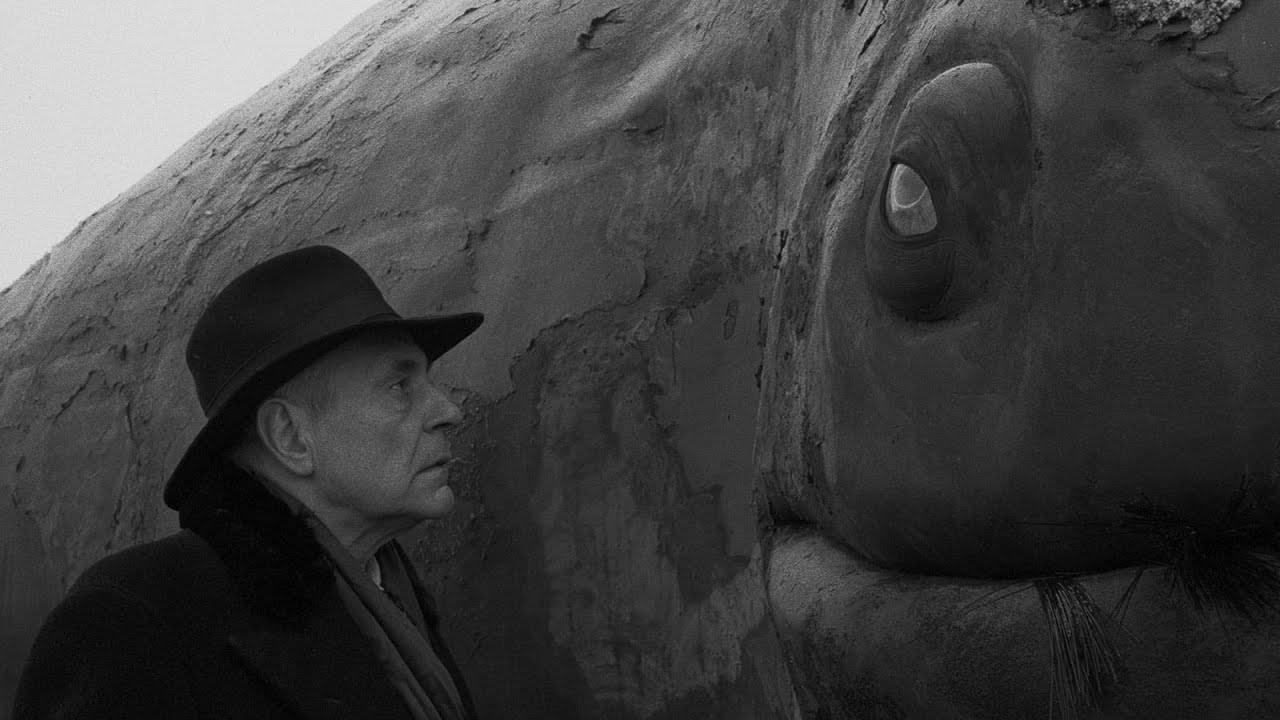
Béla Tarr and Ágnes Hranitzky’s “Werckmeister Harmonies” follows János Valuska, a newspaper delivery man who witnesses his town descend into chaos and rebellion following the arrival of a mysterious circus. The main attraction of the spectacle features a gigantic taxidermy whale and a guest appearance by the mysterious ‘Prince’. Since its release, the film’s most iconic image of a whale in the middle of a square has invited countless interpretations by film critics, theorists, and academics. Most of these interpretations have explored the political, religious and ideological themes within the film, but in doing so, they have fallen victim to “anthropomorphism, or the projection of human values and meanings onto animals, plants and inanimate objects.” (Cahill, 2013, 74) The aim of this essay is to look at “Werckmeister Harmonies” through a “creaturely” lens, in hope of presenting an alternative analysis that explores the relationship between humans and nonhumans and their vulnerability in relation to the cosmos and time.
In the film’s opening scene, we see the fire in a stove being put out by the owner of a pub. This sudden switch from light to darkness foreshadows the solar eclipse re-enactment that is to follow. As the owner of the establishment invites people to leave, one of them insists, “Just wait a bit for Valuska to show us.” Shortly afterwards, János Valuska arrives and everyone starts making room for his performance. János takes off his coat, and grabs a few drunk customers and uses them to represent celestial bodies. The man in the middle plays the Sun, another plays the role of the Earth spinning around the Sun, and a third customer mimics the Moon’s rotation. What follows is a cosmic-like dance between the drunkards re-enacting the movements of the solar system during an eclipse. Within the frame, man is placed quite literally and figuratively at the centre of the universe, which visually displays a very direct anthropocentric worldview reflecting humanity’s “narcissistic desire to recognize one’s reflection everywhere and in everything” (Cahill, 2013, 74) The fact that the “human planets” are played by stumbling drunkards suggests that regarding humankind as the central element of existence is foolish.
When János vividly describes the dramatic turn of events that occur during this natural phenomenon, the sole focus is on the animal kingdom. “The dogs howl, rabbits hunch down, the deer run in panic, run, stampede in fright.” He then explains that “in this awful incomprehensible dusk, even the birds too are confused and go to roost. And then complete silence. Everything that lives is still.” Later on in his monologue he unifies humans and nonhumans by referring to both as a single unit. “Will Heaven fall upon us? Will the Earth open under us? We don’t know.” The shared confusion of humans and nonhumans during this celestial event serve as a reminder of how we are all at the mercy of nature. In “Gravity and Grace”, Simone Weil wrote that “the vulnerability of precious things is beautiful because vulnerability is a mark of existence.” (Weil, 2012, 108) The sudden fear instilled upon the viewer, the animals, and the human beings during that precise moment perfectly encapsulates this beautiful vulnerability of all living beings.
An eclipse represents the passage of time; it marks an end and a new beginning. Throughout the film, Tarr and Hranitzky capture the in-betweenness of life by staying with the characters instead of cutting away or disrupting the flow of time. Following the bar performance, we see János walking alone in the street at night. The camera tracks back and eventually the now small figure at the centre of the screen is enveloped by darkness. This mirrors a latter scene when we see János walking away from the camera towards the brightness of the sun. According to David Bordwell, Tarr builds his films “out of conversational blocks, punctuated by undramatic routines.” (Bordwell, 2007) An example of the mundane routine of János is him walking home after a visit to the bar, and putting Uncle Eszter to bed. This sequence ends with another eclipse-like moment where we witness the shadow of a huge truck overtaking the light reflected on the house fronts. These long takes linking the mundane with the eventful results in a long-take aesthetic reflecting the rhythm of everyday life. The average shot length in “Werckmeister Harmonies” clocks in at three minutes and forty-eight seconds (Bordwell, 2007). By rejecting a ‘cut’, the film forces us to feel trapped in time. In “The Cinema of Béla Tarr: The Circle Closes”, András Kovács argues that Tarr uses “circular narrative structure and extreme narrative slowness” to express the “human situation represented as a trap from which there is no escape” (Kovács, 2013, 5) However, this take neglects to acknowledge the nonhuman presence at the heart of Tarr’s work. In “Critical Terms for Animal Studies”, Anat Pick criticizes the notion of “art as an expression of ‘the human condition’” and refers to the idiom as a desperate attempt “to shore up the human as a unique ontology” (Pick, 2018, 414) In fact, animals are “at the center of Béla Tarr’s most difficult films” (Pfeifer, 2013). The vulnerability of the cat in “Sátántangó”, the horse in “The Turin Horse”, and the whale in “Werckmeister Harmonies” invite viewers to look beyond our tendency for a humanistic focus on cinema.
The whale doesn’t have much screen time in “Werckmeister Harmonies”, yet its presence looms over the entire film. The film’s lengthy duration and natural progression even resembles the mysterious creature; “Werckmsieter Harmonies” is long and moves forward slowly yet gracefully. From the moment the whale arrives, the townspeople question what this means for them. As János goes to pick up the newspapers, he is greeted by Uncle Béla and his wife. She asks him “How are things at the cosmos.” To which he replies, “Everything’s fine.” The irony is that he delivers the news in this town yet, he is completely oblivious to what is actually happening around him. In literature, János would paradoxically be referred to as a “wise fool” for they hold wisdom, yet fail to illuminate the significance of everything happening around them. (Walter, 2005, 515-520) In that same sequence, we see János sitting on the left side of the screen folding newspapers, when the camera slowly tracks in to the woman in the background as she complains about various aspects about the state of things. The camera movement signifies the importance of what she is saying. She mentions families disappearing out of nowhere, and complains about the cold weather and how there is no coal to keep them warm. During this “conversational block”, she mentions the arrival of the “horrible great whale” and the three-eyes prince, which is a very different description compared to the circus advertisement on lamp posts (Fantastic: The World’s Largest Giant Whale! And Other Wonders of Nature! Guest Star: The Prince). These opposing views and images of the whale is further touched upon in another scene where another local, Uncle Karcsi, talks about the rumours swirling around town. “Some say there are at least three hundred of them, someone else that there’s only two of them actually, and that the whole attraction is the most frightening thing that you would ever see.” It is hinted upon that the whale could be like a Trojan horse, or not. He talks about how people are saying the whale has no part in it, while others fear it is the cause of it all. These juxtaposing views signify uncertainty, which disrupts the order of things and leads to chaos.
When we finally do see the whale through the eyes of János, the camera follows our protagonist at eye level. We occasionally linger on the faces of the townspeople who stand motionless around the whale. There is a moment of cinematic spontaneity of birds flying above the townspeople. As people stand silently waiting, we hear the flapping and fluttering of wings; signifying the flocking of humans and nonhumans to the square. Eventually János buys a ticket and studies the whale within the darkness of the truck. His gaze is that of wonder reflecting the sentiments of the circus advertisement. He tells a fellow bystander, “Nothing wrong with it. Just see what a gigantic animal the Lord can create.” His fascination with the creature is very cosmological. When wildlife photographer Bryant Austin known for taking close-up photographs of the eyes of whales described an eye-to-eye encounter with a sperm whale, he writes, “I noticed his eye moving along the length of my body before returning to meet my gaze.” He writes that it made him re-evaluate his “perceptions of intelligence, conscious life on this planet” (Austin, 2013). In his essay, “One of Us”, John Jeremiah Sullivan writes that “accepting that no two consciousness can ever have transparency, or at any rate can never have certainty about it, leaves us on some level cosmically alone. (Sullivan, 2013) The difference between these cosmic fascinations of the whale, is that János is looking at an unconscious whale, while Austin and Sullivan are referring to encounters with conscious whales. When János mentions that nothing is wrong with the whale, he fails to see its unnatural condition, or even recognize the horrors it endured. He sees the whale for what it represents and not for what it is, an animal dragged out of its natural habitat rotting and decomposing in the middle of a square. When writing about taxidermy, Donna Haraway wrote “the animal is frozen in a moment of supreme life, and man is transfixed.” (Haraway, 1989, 30) The whale’s representation evokes feelings of wonder, when in reality it reflects an anthropogenic vision of extinction and the unethical human disruption of creaturely harmony in their natural habitats.
Even though “the capturing of the animals was a symbolic representation of the conquest of all distant and exotic lands.” (Berger, 21), when the circus arrives, the town loses control and descends into complete chaos. The scene in the square mirrors the one in the hospital later on in the film. Only this time, everything is reversed establishing a connection between human and nonhuman atrocities. The camera follows the mindless mob looting and destroying everyone and everything in their path till the camera lands on the image of an old weak man standing in his bathtub. They instantly stop what they are doing, and withdraw from the scene. It’s almost like they come face to face with the fragility of their existence. The appearance of the skeletal gaunt man also brings to mind “the image of a concentration camp victim”. (Rosen, 2016) In other words, a time when masses acted without consciousness. While the conscious (humans) are surrounding the unconscious (whale) in the square, the unconscious (mindless mob) is surrounding the conscious (frail man) in the hospital. Human and nonhuman vulnerability to historic atrocities caused by outsiders is at the centre of the two most memorable sequences of “Werckmeister Harmonies”.
Perhaps this is what the musicologist, Uncle Gyorgy, refers to when he talks about how Andreas Werskmeister commercialized a system of harmonies through the tuning of instruments, which ultimately clashed with the music of the celestial spheres, or the natural harmonies of the world. Throughout his speech, the camera rotates around him, the same way it rotated around János during the cosmic bar dance between the planets. Through cinematic means, a clear link is established between the eclipse sequence and the Werckmsieter speech. The same can be said about the sequences of János witnessing the whale in the square, and János witnessing the mob in the hospital; János finally wakes up to the ugly reality of the world. Our disconnection with nature and the separation between humans and nonhumans has disturbed the natural harmony of the cosmos. There is one shot that perfectly encapsulates the possible harmony that could exist between humans and their environment. We see the camera fixed on a close-up of János and his uncle as they walk from one block to another. The sequence drags on for some time, but gradually the sounds of their footsteps merges with the sound of leaves and the gushing winds. At this moment, the sound design creates a beautiful rhythmic harmony, as man becomes one with the natural elements. The human and his nonhuman environment get intertwined, or as Dai Vaughan would say, “man, no longer the self-presenter, has become equal with the leaves”. (Dai Vaughan, 65)
By studying the relationship between the human and nonhuman, chaos and order, light and darkness, “Werckmeister Harmonies” presents itself as a cosmic vision of creaturely vulnerability to the inescapable atrocities that come with time. The film ends with the destruction of the town, and our protagonist mad in a hospital. Yet, the final image of Uncle Gyorgy revisiting the whale, now stripped of all its wonder, gives off the sense that the truth of the world has finally been laid bare. But in the final moments, a fog envelops the square, the town, Uncle Gyorgy and the whale. Both the human and nonhuman are overtaken by a natural phenomenon. The uncertainty of what time holds for both still looms in the air.
Bibliography
Cahill, J.L., (2013) Anthropomorphism and Its Vicissitudes in Pick, A., Narraway, G., Screening Nature: Cinema beyond the Human (1st ed.). Berghahn Books.
Weil, Simone. (2012). Gravity and Grace. Abingdon, Oxon: Routledge.
Bordwell, D. (2007, September 19). The sarcastic laments of Béla Tarr. David Bordwell’s website on cinema http://www.davidbordwell.net/blog/2007/09/19/the-sarcastic-laments-of-bela-tarr/
Kovács, A. B. (2013). The Cinema of Béla Tarr: The Circle Closes (Directors’ Cuts) (Illustrated). Wallflower Press.
Pick, A. (2018) “Vulnerability,” in Critical Terms for Animal Studies, Lori Gruen, ed. Chicago: University of Chicago Press
Pfeifer, M. (2013, January). Bad Animals: Some Ideas on the Meaning of Béla Tarr’s Animals. East European Film Bulletin. https://eefb.org/perspectives/some-ideas-on-the-meaning-of-bela-tarrs-animals/
Kaiser, Walter (2005). “Wisdom of the Fool.” New Dictionary of the History of Ideas. Horowitz, Maryanne Cline, 1945-. [New York?]: Charles Scribner’s Sons. pp. Vol. 4, 515–520.
Austin, B. (2013). Beautiful Whale. Harry N. Abrams.
Sullivan, J. (2013). One of Us. Lapham’s Quarterly.
Haraway, D. 1989, “Teddy Bear Patriarchy in the Garden of Eden, New York City, 1908–1936”, Primate Visions: Gender, Race, and Nature in the World of Modern Science, Routledge, London.
Berger, J. (1980) Why Look at Animals?, About Looking, New York: Pantheon, pp. 1-28.
Rosen, A. (2016, May 5). The Importance of Béla Tarr’s ‘Werckmeister Harmonies.’ Tablet. Morton Landowne
Vaughan, D. (1999). Let There Be Lumière. In For Documentary Twelve Essays (First Edition). University of California Press.
 The Cinephile Fix