When “Iron Man” was released two years ago, I remember leaving the theater hungry for more. Now that Jon Favreau has come up with the sequel I can’t help but want less. By less I mean less of a lot of things. Less characters, that’s for sure. The film introduces so many new characters without taking the time to develop them, it becomes almost repetitive.
I constantly found myself saying “Oh, there’s Scarlett Johansson as the Black Widow; Mickey Rourke looking badass as always. Wait a minute Don Cheadle replaced Terrence Howard? Sam Rockwell is in this too? Oh looky here, it’s Samuel L. Jackson in yet another below average superhero movie.”
Don’t get me wrong I have nothing against ensemble casts, as long as each character has purpose, is well-developed and supports the overall flow of the film.Unfortunately, this is not the case here. Scarlett Johansson and Samuel L. Jackson’s characters did nothing for me. They were both unnecessary to the plot and quite frankly felt like characters from another movie who just happened to run into the set of “Iron Man 2”. I have no problem with Don Cheadle replacing Terrence Howard though, he stayed true to Howrard’s performance in the predecessor. While Rourke needed more character development, Rockwell was the surprise showstealer.
Less storylines and more focus is another thing this film needed. Favreau should’ve focused on one basic storyline instead of losing grip of the direction of the plotline and wasting what could have been a great sequel. The film starts with Ivan Vanko also known as Whiplash (Rourke) witnessing the death of his father. We get that Tony Stark is somehow responsible for it and so in an attempt to avenge his father’s death, Ivan builds his own cheap electronic vest. Meanwhile Tony Stark is busy trying to prevent the US army from getting their desperate hands on his suit. We also learn that the arc reactor attached to his chest is both keeping him alive and killing him.
After completion of his vest, Rourke takes a shot against our hero during a Formula 1 race. Yes, a Formula 1 race. Why you ask? Well, apparently we need hundreds of people watching as Rourke stands up against Stark, in addition to that, there also has to be some explosive action like cars flipping into the air and crashing into one another. The location is a lame desperate excuse to make the standoff a fireworks show. The “he did it to show people Stark wasn’t invincible” is a stupid argument. Did everyone forget about Jeff Bridges using Iron Man as a metallic frisby?
Suddenly, the story switches focus from Whiplash to Stark’s main business competitor, Justin Hammer (Rockwell). Hammer is sick of living in Stark’s shadow and so teams up with, well you guessed it. The main villain becomes a minor one and then returns once again to the center of attention. In addition to all that you have subplots including a childish fight with his best friend, Col. Rhodes (Cheadle), Pepper Potts (Paltrow) getting promoted, Stark (Downey Jr.) coming to terms with some Daddy issues, and an introduction to the Avengers.
Another negative aspect in “Iron Man 2” is the over use of far-fetched technology. It was fun in the first film but they overdid it with the sequel. It was almost an in your face display of the bigger budget. Part of what made “Iron Man” so special was the relevant theme of terrorism, which is absent here. Also, in the first picture, there was something about that suit that made it unique and special. However, “Iron Man 2” introduces so many different armour suits with special attachments, our hero’s suit only becomes less impressive. In fact, we get so many suits in this film, I’m surprised they didn’t just title the film, “Iron Men”.
Now that I’m done discussing the negative aspect, I’ll point out that the action sequences were somewhat impressive in terms of editing. Thank God, this wasn’t filmed in 3-D because it would’ve resulted in me adding another paragraph to my negative review.
By now most of you must have heard of my success of getting to Ebertfest. For those of you who don’t know here’s what happened. I had lost all hope and went to the airport in Doha to buy a ticket back to Egypt. I was standing in line to get that ticket when my father pointed to a TV screen. “London Heathrow airports are back in business. For the time being only those with cancelled flights will be served.”
Before booking the ticket, I asked the guy behind the counter to find me a route to Champaign. It was my last attempt and also my last chance to at least attend one full day at Ebertfest. It took the guy about thirty minutes to find a route to my final destination. “That’ll cost you $8,200.”, he said. My father looked at me and asked how much my previous ticket cost. I told him that it cost me around a thousand. By chance, a representative from British Airways was passing by and overheard our conversation. He then turned to us, and told us that if our previous flight was cancelled due to the volcanic ash, BA would take care of the costs as long as I fly with either British Airways or American Airlines. The stars must have been aligned for me, because the route we found was all American Airlines. Anyway, so they gave me the ticket, but there was still a problem. I would go from Doha to Bahrain, from Bahrain to London, from London to Chicago, and from Chicago to Champaign. Two of these flights were still not confirmed, so they put me on standby for the flight the next day.
That day, I told no one, except for Roger Ebert and Mary Susan, about my tiny chance of attending this one day at the festival. If everything went well, I would miss my panel discussion, but I’d attend the 24th and the last screening on the 25th. That was good enough for me. Besides it was either that, or back to Egypt.
We went back home at around 2 a.m. My father went to sleep right away. I stayed up all night; I just couldn’t sleep. Whenever I would close my eyes, I’d think of meeting the foreign correspondents, Roger and Chaz. I thought of how happy I’d be if I got that seat, and of course, how sad it would be to get disappointed one last time. I couldn’t take that anymore.
I slept for an hour or two at around 8 a.m. When I woke up, I packed my last few items, and started heading to the airport. I waited and waited; people kept coming in and my little hope for that seat began to vanish. Finally, at the last moment around 8 p.m., the airline representative approached me, “You’re lucky. Someone didn’t show up.” I said my goodbyes to my father, and checked my bag in. I was still in disbelief, and didn’t think of it that much at the moment. I tried to contact Roger or Mary Susan, but the internet reception there was terrible.
The following 23 hours (16 hours of flight) felt like a week, as I stopped in Bahrain, London, and Chicago, rushing from one terminal to the next. The last thing I wanted was to miss my flight, and blame the failure of arriving to Ebertfest on myself instead of the volcano.
When I finally got to Chicago, I sent Omer Mozaffer a message:
“Hi Omer. It’s your buddy Wael. Ezayak? (Arabic for How are you) I can’t reach Mary Susan or Roger. I just arrived in Chicago.”
Omer later told me that at that precise moment, he read the message and showed it to Roger. Roger read it and his eyes widened by the surprise arrival. Omer, aka the unofficial leader of the foreign correspondents, then replied to me and gave me directions to the hotel I was to stay in. I waited at the airport for 6 hours before my short flight to Champaign took off.
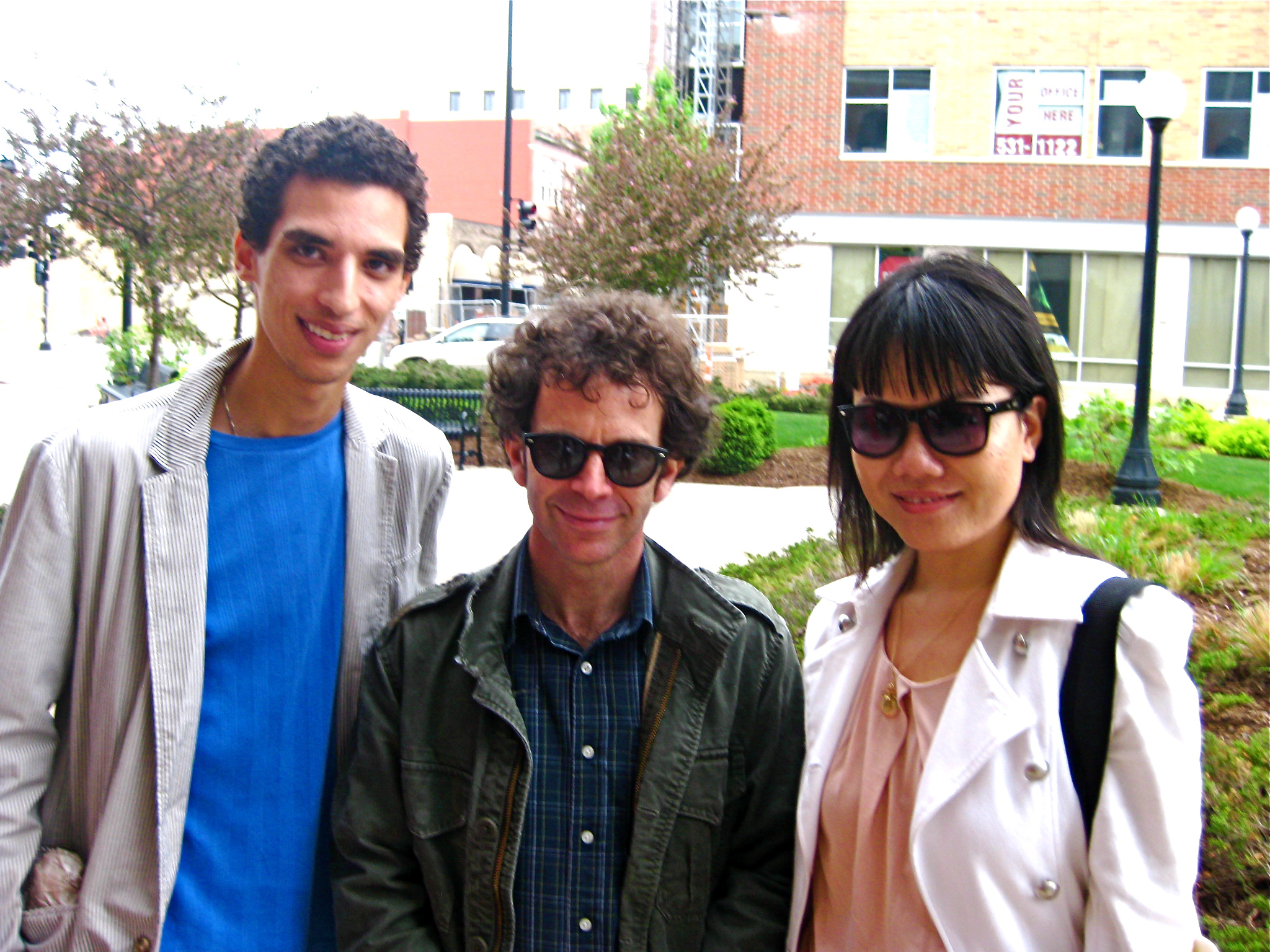
When I arrived there, it was Friday night, around 8 o’clock. Meanwhile, everyone was watching “Synecdoche, New York”, so I took a cab to the Illini Union Hotel and checked in. I was very tired but decided to attend the mid-fest party late that night. Grace Wang was kind enough to pick me up since I didn’t know where to go or anything. She turned out to be this wonderful person, much nicer than her already kind personality online. That’s when I first met Tom Dark. We clicked in an instant. On our way to the party, we talked about everything from the things I’ve missed in Ebertfest to my blog entries.
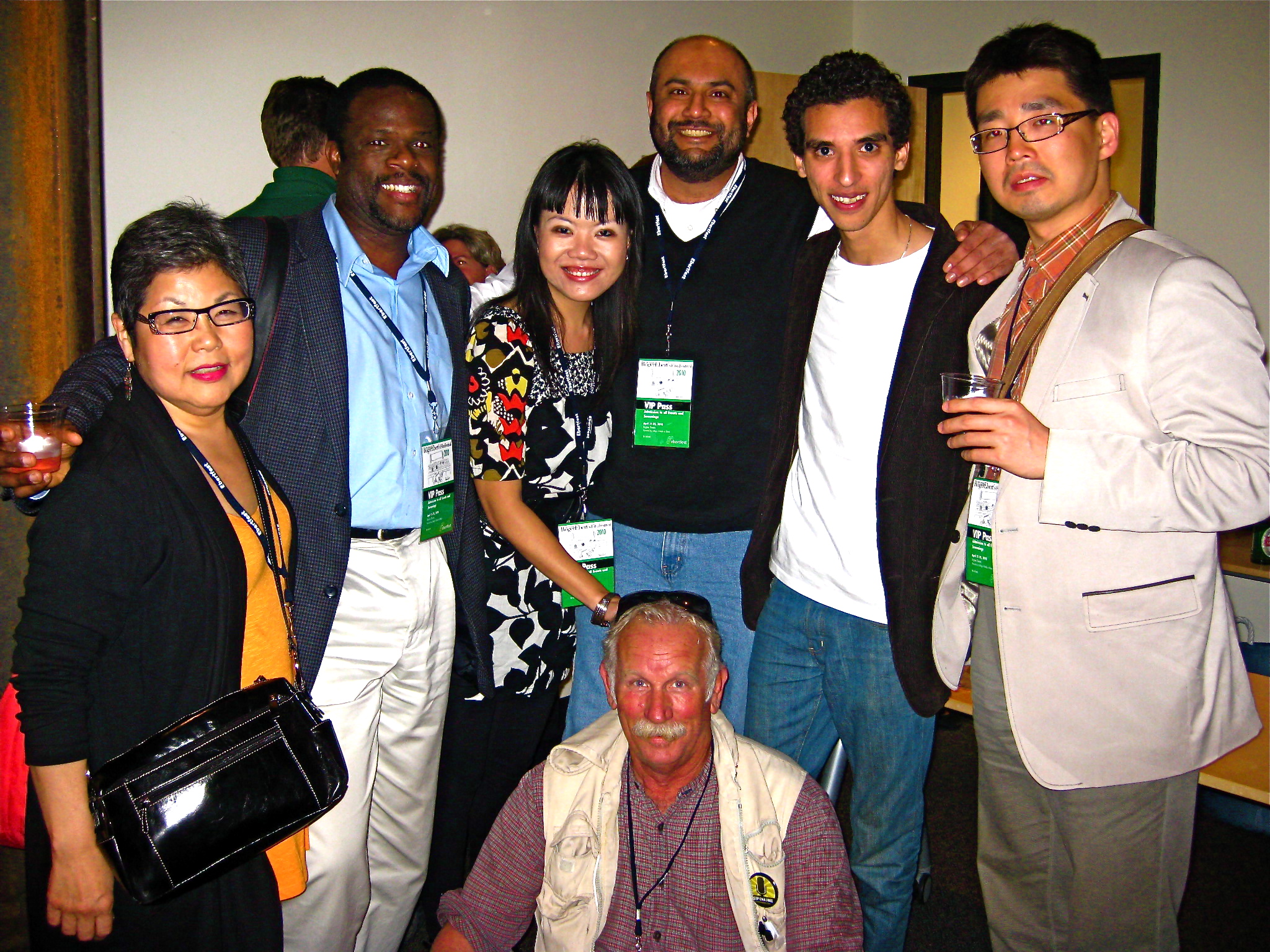
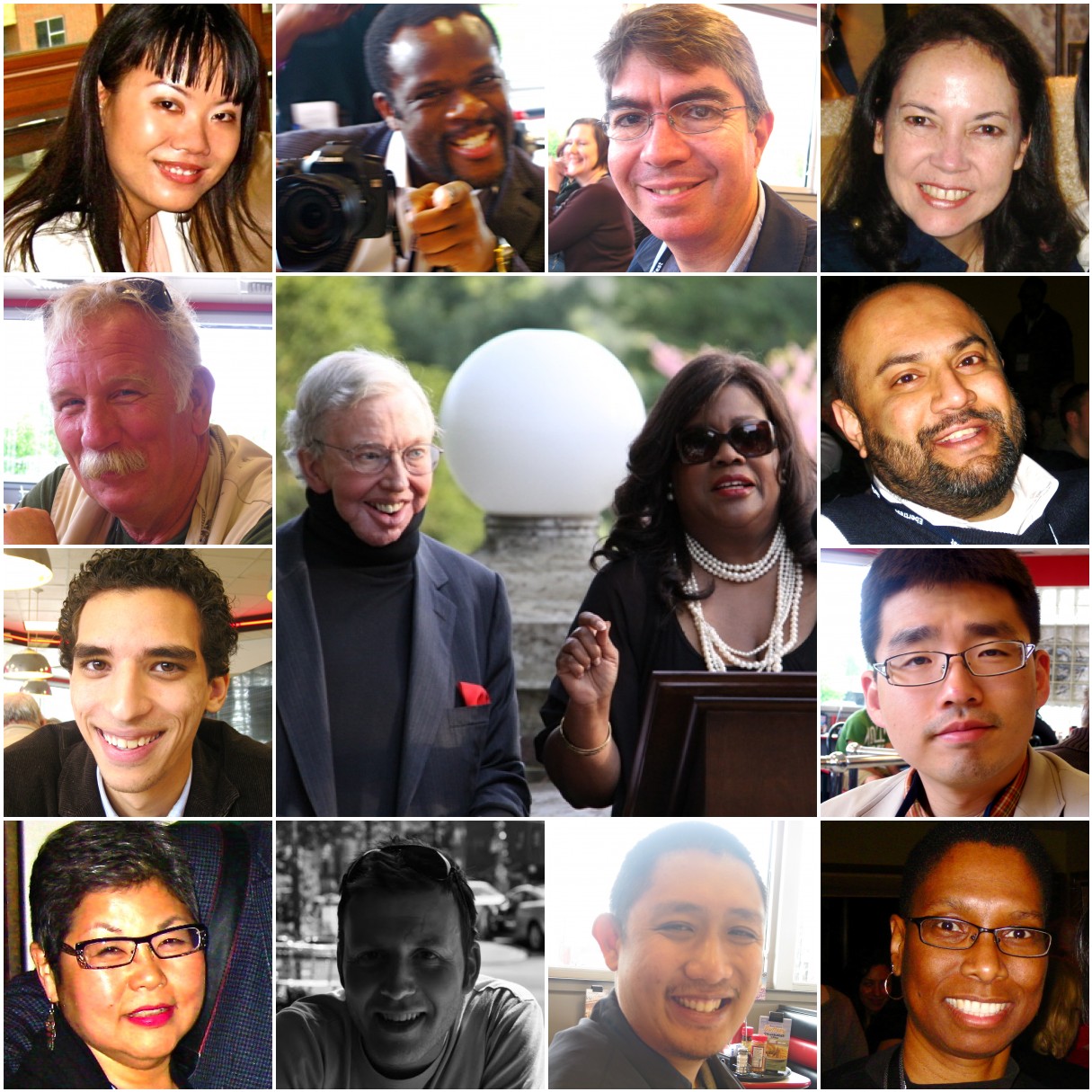
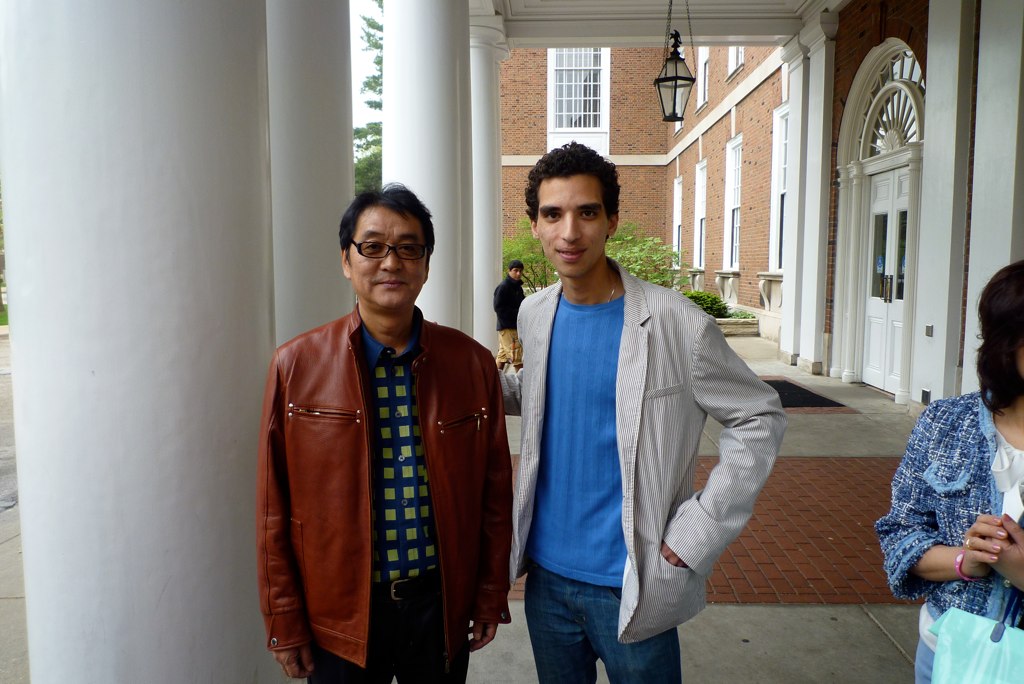
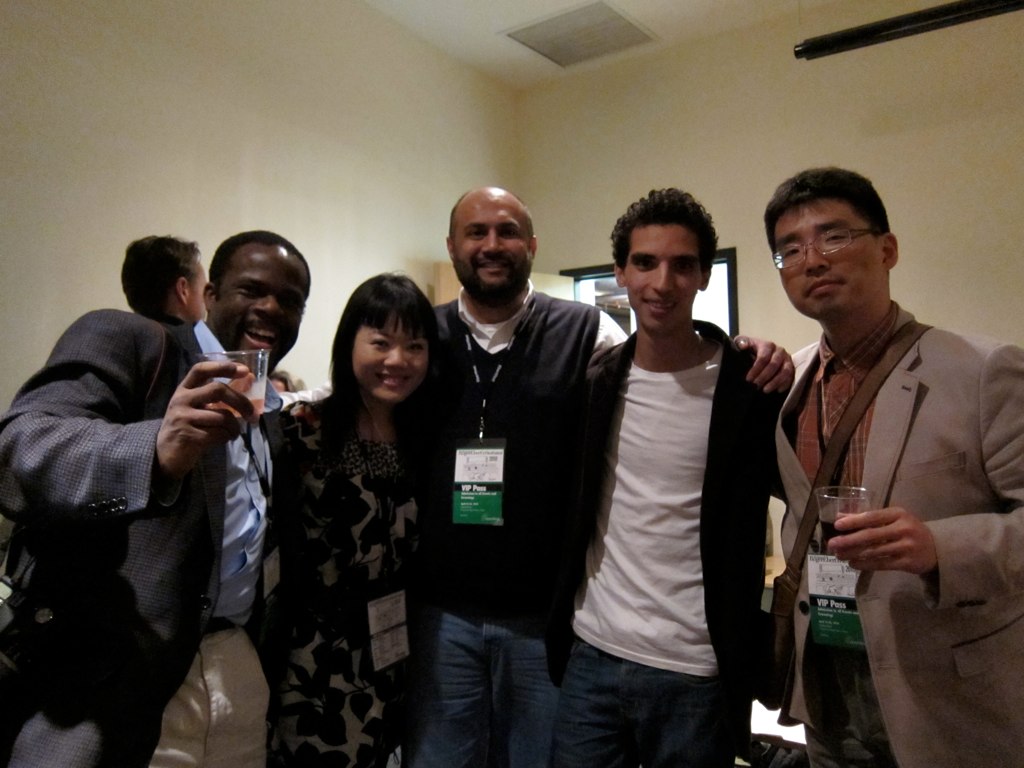
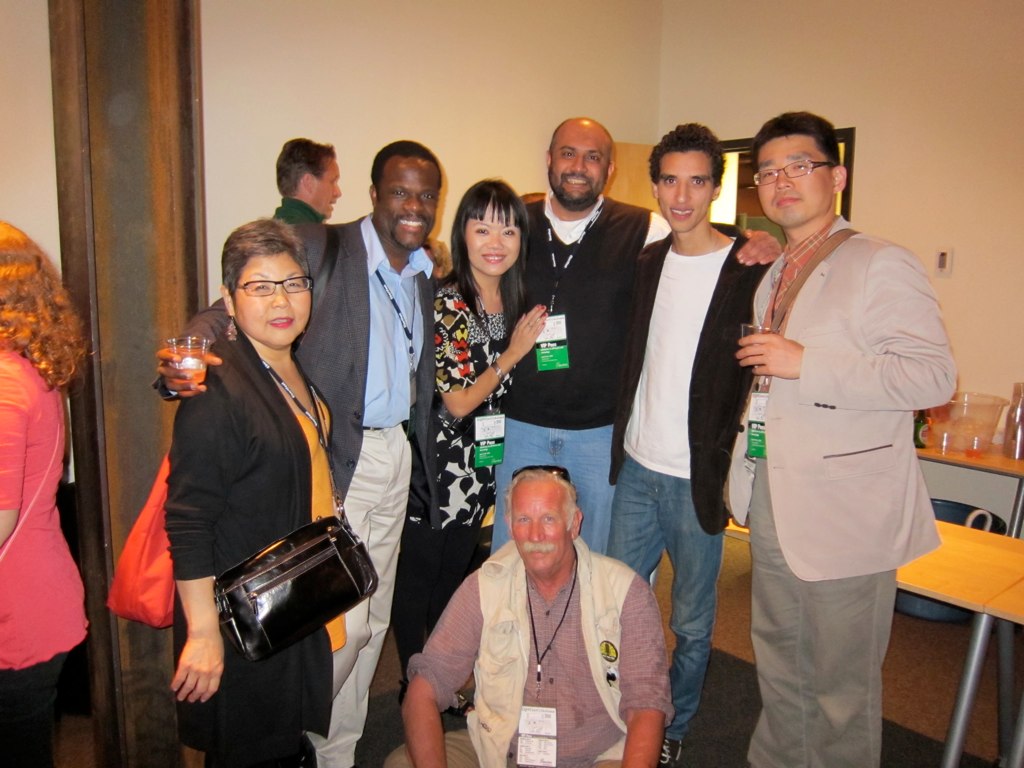
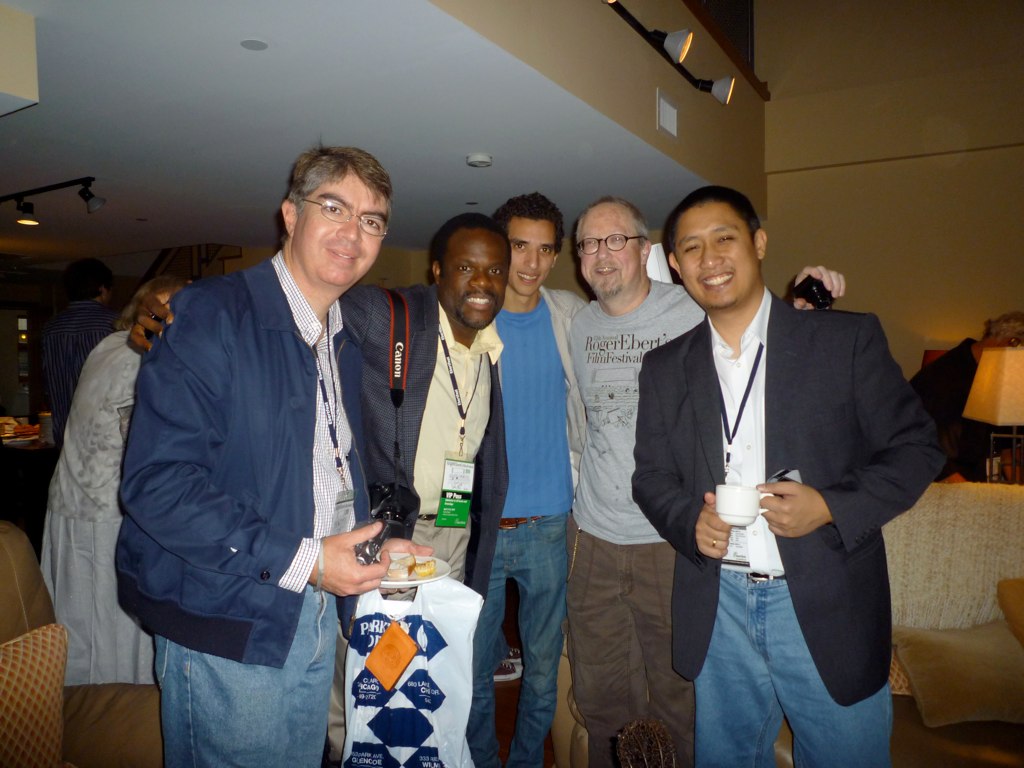
The party was very crowded. Grace spotted the rest of the foreign correspondents, grabbed me and lead me through the chatting crowd. Omar Moore, Omer Mozaffer, Seongyong Cho and Michael Mirasol were there. Each of them greeted me with a hug and several “You MADE IT!” celebrations. They were most welcoming. We chatted a bit and then I asked about Roger. He couldn’t make it to the party, since he felt tired and wanted to call it a night. They told me that I’d meet him at his place the following day where Chaz and Roger would be having a breakfast party for us bloggers. I was most excited. I was also interviewed by Sandra Kofler from the Wall Street Journal. She mentions me in her article about the festival here: http://j.mp/dBYIrU
I spotted Charlie Kaufman from across the room. He was very busy answering all kinds of questions about the recent screening of his masterpiece. A few minutes later my main man, Evan (an Ebertfest volunteer) walked me home. I needed some sleep if I wanted to wake up for that breakfast at Roger’s place.
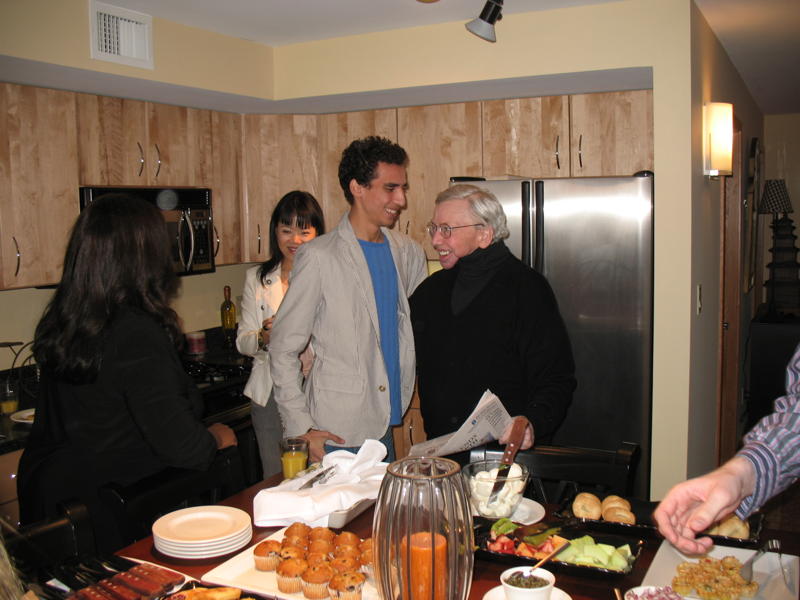
The next day, I met up with Grace, Omer, the wonderful Gerardo Valero, his sweet wife and Tom. The group of 6 or 7 then split up into two cars. I went with Omer. We all knew that Roger had not seen me yet and Omer was particularly excited to see his reaction. Carol (Roger’s assistant) let us in after a few minutes of standing in front of the elevator. When Chaz saw me she gave the most welcoming hug. “I can’t believe you’re actually here.” she said. I kept smiling and told her how glad I am to finally make it. We then went inside and enjoyed the coffee, croissants and so on. I mingled with the crowd and met some wonderful people including the executive producer of Chaz and Ebert’s upcoming show, and an old lady from Canada who was just adorable. I hate myself for forgetting her name. I asked her “If you could recommend just one Canadian film, what would it be?” “Shake Hands with the Devil”, she replied. Another film was added to the wish list.
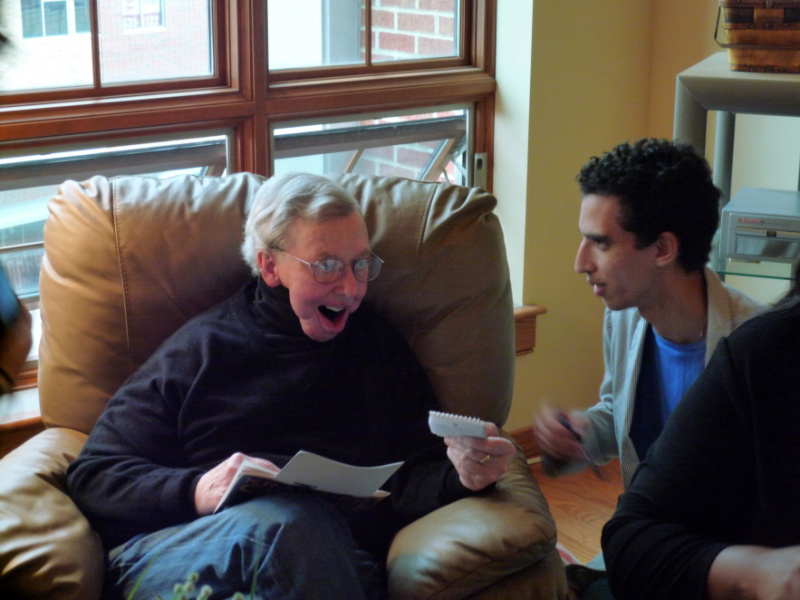
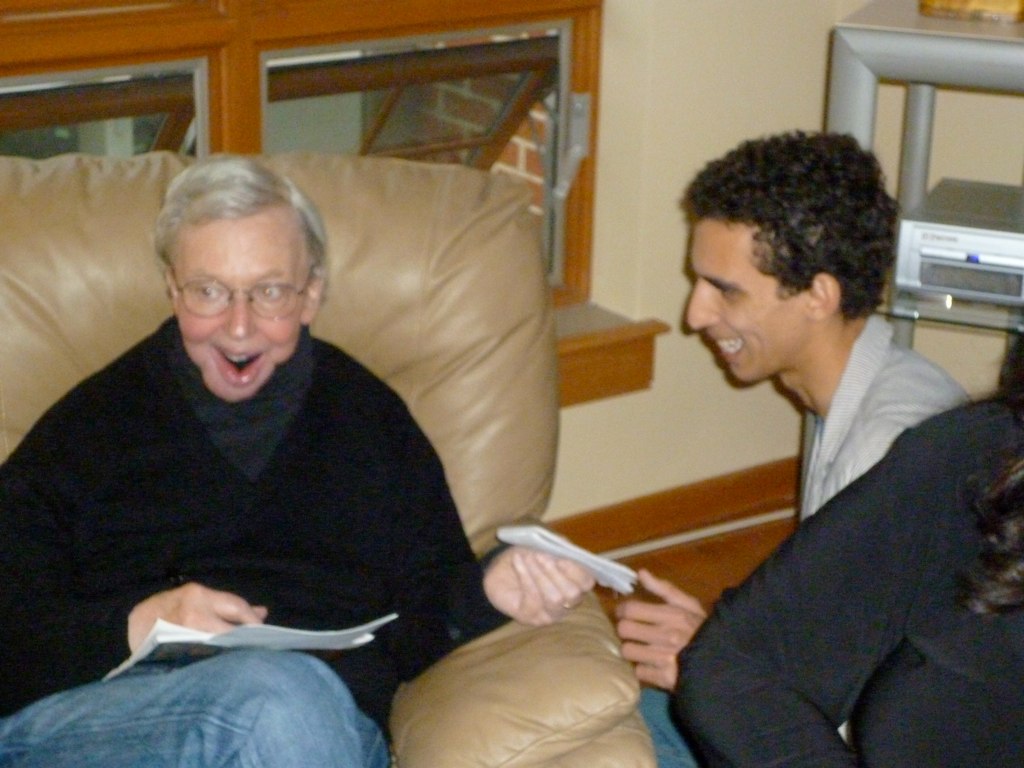
Roger was still upstairs but after about ten minutes he came down. I looked at him, he looked at me. “Look who made it. Wael from Egypt.”, Omer said. We then hugged each other. “It’s an honor sir”, I whispered. Everyone was looking at us and I was at the happiest state of my life. My mentor was shaking my shoulder with joy. Gerardo took a few pictures of us smiling at each other. I hope he sends them soon. I’m smiling right now just writing about that moment.
The small party went on and I met some other interesting individuals. Everyone seemed to know who I am. Apparently, Roger and Chaz would update the audience every day about the progress of my trip. I must’ve gotten dozens of “We’re so glad you made it. Your trip was so dramatic. But YOU MADE IT!” I’d smile each time to the strangers. The then strangers are now friends.
At one point I spotted Roger sitting on his chair when nobody around him. He was all alone, so I jumped at the chance and sat next to him. We talked about my grandfather, my jetlag, the updates of the festival, and how I’d go through everything again just to meet Roger, Chaz and the far-flung gang as I like to call them. He also signed the festival program for me. “To Wael, My Friend. Roger” I appreciate the autograph, but it’s the “My Friend” part that has me gazing at the cover every hour. I later purchased 6 of his books. Someone asked me, “Aren’t you going to get him to sign them for you?” I didn’t want him to sign. I didn’t want to feel like a fan (which I am) but a friend (which he is).
An hour or so later it was time for all of us to head to the festival. I waited outside with Grace and Omer. Charlie Kauffman came and joined. I told him who I was and where I’m from, we shook hands, and I told him how many times I had seen “Synecdoche, New York” (5). He was amazed that the film was even released in Egypt. I also told him that I admire the fact that he doesn’t explain his film in interviews and how he should never reveal more than what is displayed on screen. “It would ruin it. What I love most about your films is the fact that every time I re-watch them, I get something new out of the experience.” He nodded and said something in the lines of “I really appreciate you saying that because I get a lot of shit about that.” He was leaving Ebertfest shortly after, so I shook his hand and said goodbye. I was glad to meet the greatest screenwriter alive before missing the chance.
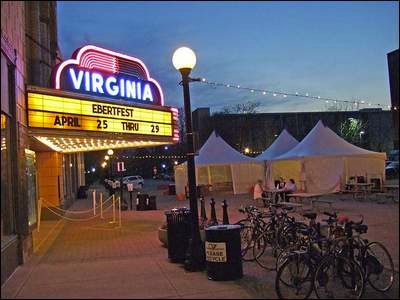
Tom Dark, Grace, and I started heading to the Virginia Theater. We grabbed cups of coffee from a café on our way. When we finally got there, I realized that I had no pass. Grace told me about a gift-bag that contained the pass but my room didn’t have that. We tried explaining to the volunteers that I was a foreign correspondent but they only appointed us to someone else. They were doing their job. By luck at that moment Roger was entering the theater. He pointed at me, we shook hands again, and then he waved his hands into the entrance. This time nobody dared to stop me on my way in.
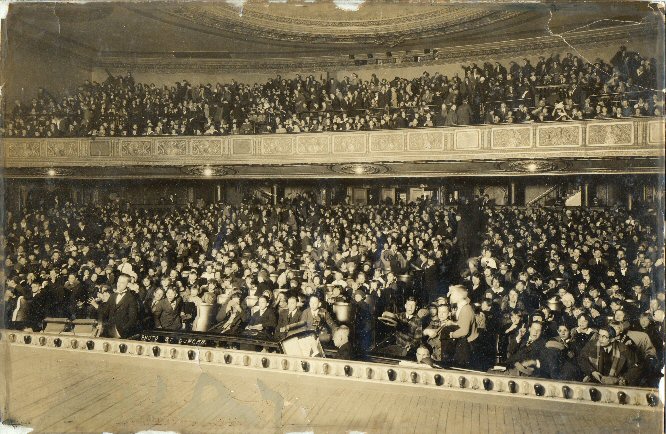
Once inside, I admired the Virginia Theater, studying every single detail of the beautifully preserved design of the place. The theater was pretty much full but I managed to find a seat upfront. I was then approached by another volunteer who asked for my pass. “You can’t sit there.”, he said. “Yes, he can” said a voice from behind me. It was Tom Dark, he had saved a seat for me all the way at the back, a few seats next to Roger. A few moments later Chaz came up on stage.
“I’m very happy to tell you some of the people have been blogging and tweeting and the News Gazette wrote an article about one of our foreign correspondents who couldn’t come. Wael Khairy, from Egypt, Wael is here. Wael stand.” _Chaz
A thunder of applause followed. I stood up put my hand on my heart. I kept smiling for the ten seconds of applause. The hundreds or a thousand of seated people turned around and looked at me as they continued to applaud. I couldn’t think straight. I was being introduced and put on the spotlight. I can write a long list of adjectives describing how I felt at that moment (proud, happy, thankful, happy, grateful, happy, touched, and very happy).
We then watched a nice British film called “I Capture the Castle”. It was my first time seeing the film, and I enjoyed it very much. I didn’t think it was a masterpiece but still, it was much better than most family films I can think of. At the Q & A, Grace Wang discussed how the film was about adolescence. Another panelist (the daughter of the costume designer) thought the film was essentially about love, a member of the audience said it was about the process and struggle to write. I thought it wasn’t about any of this and about all that too. Let me explain, the way I saw it, it was about the discovery of things, be it love and how it can be both beautiful yet painful at the same time, the discovery of an adolescences’ sexual frustration, the discovery of what it’s like to have a first kiss, and the discovery of that tiny spark that brings an end to a writer’s block. I wanted to raise my hand and say all that but by the time my thoughts had formed, they had picked the last question by the audience.
After the Q &A, I went to get more coffee to stay awake. I went outside to catch a breath of fresh air and saw Tom smoking one of his cigars. We talked about my censorship incident and went back in shortly. The same executive-producer from last time handed me an All-Screenings Pass, just in case anything happened. The next screening was “Vincent: A Life in Color”. I sat up front next to a film professor from Ohio. We talked a lot and he turned out to be quite a guy. Right behind me sat Gerardo and his wife. I greeted them once again and Gerardo told me “You know what Wael, they should do a statue of you.” What a compliment? “Huh? Why?” He told me that the day before, Roger, and Grace and himself were discussing the subtitle incident. I was touched by the fact that they thought of me while I was gone. He also told me that during their panel discussion, my far flung buddies shouted out at the camera that they miss me and that they wished I was here. Again, I was very touched. It seems like everyone was so welcome, nice and thoughtful. I just couldn’t help but keep smiling randomly throughout the day.
“Vincent: A Life in Color” was one of the most uplifiting feel good documentaries I had ever seen. I was surprised that it wasn’t as well known as it deserves to be. The choices Roger picks for his festival are truly unique and pitch perfect. I saw Vincent himself at the breakfast party but I didn’t know who he was. At one point he put his hand on my blazer and said “Ouuu feeling groovy?” After the documentary I appreciated that random moment even more. The entire audience was touched by his story, at parts everyone was smiling, at others the room was so quiet you could’ve heard a fly pass by. “Vincent: A Life in Color” is a bittersweet masterpiece of a documentary. I love the fact that it started out by displaying Vincent as this crazy guy dancing on a bridge wearing weird suits, and then it kept getting closer and closer to Vincent the man not Vincent the public image. Eventually, the wide shots got closer narrower up till a headshot interviewing the man at the end. I still don’t understand the motif of his actions but that’s exactly what I love about the man’s spirit.
After the credits rolled, Vincent came up on the stage and did his little performance of twirling his suit. A standing ovation followed. After that the Q & A started. I was surprised that it was the director’s first film and that she paid for every cent. She was a waitress first, and suddenly got the idea of doing a documentary on the by now urban legend known as, well he’s known as a lot of things.
During the break, Chaz came up to me and introduced me to Melissa Merli from The News Gazette. I was interviewed by her outside. She was very nice and I thanked her personally after picking up several copies of the newspaper on Monday. I asked Roger to thank Chaz for me. It was mighty kind of her to get me that interview. You can read all about it here: http://j.mp/bGY13B
After the interview we went back in to watch “Trucker”. It exceeded my expectations and I now consider it one of the best films of 2008. The performances were what surprised me most. Michelle Monaghan delivered a once in a lifetime performance and I can see her career taking off the way Charlize Theron’s career took off after “Monster”. There’s one shot in that movie that I think is simply beautiful. It’s when Diane Ford and her son sit in the middle of nowhere facing the screen with a gap between them and an empty landscape of desert as the background. It takes place much earlier in the film which is when both characters are quite distant from each other, the emptiness of that shot with the vast space expressed so much about the characters at that stage of their lives. As the film progressed, the gap between them eventually vanished and they end up in each other’s arms. I was also struck by the realistic friendship between Diane and her best friend, Runner played excellently by Nathan Fillion. Especially since my best friend is girl (Amina). I understood many of the scenes of them together and how they were the only ones who truly understood each other. The theme of their relationship touched me more than any chemistry between two fictional friends in a long time.
About an hour later, I was enjoying the company of Grace and Tom once again in the Green Room. We talked about his work, her potential future as a writer, and how the book about Egyptian censorship and piracy that I’m working on will probably never see the light of any bookshelves till the Egyptian government changes for the better. Roger Ebert was also the subject of our conversation. We talked about his generosity and how interactive he is, being one of the few critics who have daily conversation with their readers. As soon as the vegetarian macaroni dishes were wiped by our appetite, we headed back to the festival for the final screening of the day, “Barfly”.
I knew about the film but never got the chance to actually seeing it. Now that I have, I can honestly consider it one of the greatest films of the 80’s. Mickey Rourke’s performance is one of the greatest male lead showcases in film history. I was shocked to find out later on that he wasn’t even nominated in 1987. Upon learning that I recalled the Academy’s other 80’s mistake of not nominating Robert De Niro in “The King of Comedy”. “Barfly” is so deep and layered with philosophical themes wrapped up in a hilarious yet dark screenplay. I don’t think I’ve ever seen anything quite like it. It’s the film I enjoyed most out of the five films I enjoyed there. The Q & A was one of a kind with the surprise appearance of Barbet Schroeder. He shared some interesting stories about the making of the film and the subject of his story, Charles Burkowski. At first I thought the film was ok, but now that it has grown on me, I think it’s a masterpiece that should be considered a modern classic in years to come.
As soon as the day came to an end, I had to get some sleep. The caffeine effect was no longer working and my eye-lids became more and more heavy. Instead of going to the party, I went to sleep and finally got some proper rest. Waking up the next morning, I met the wonderful Jim Emerson. I knew him from Roger’s blog and read his reviews for the past year. He’s probably the only film critic other than Ebert that I follow too. He told me how dramatic my arrival was and how he was so very glad that I made it. We talked about Egypt, and he showed me the tattoo on his arm of the Eye of Horus. I love that symbol which is why I got Grace a silver necklace of that same symbol from Egypt. The eye is represented as a figure with 6 parts. These 6 parts correspond to the six senses – Touch, Taste, Hearing, Thought, Sight, Smell. These are the 6 parts of the *eye*. The eye is the receptor of *input*. It has these six doors, to receive data. It was also believed to be a protective symbol. Anyway, Jim was very kind, warm, welcoming and generous enough to mention me in his Ebertfest wrap-up article: http://j.mp/c5IpD9 I bought myself a few copies of this Chicago Sun-Times issue from the airport the following day.
The last screening of Ebertfest was the heartbreaking documentary, “Song Sung Blue” about Thunder & Lightning, their ups and downs. I couldn’t help but think of how emotionally similar the couple’s journey was to that of Roger and Chaz. It was a fitting end to greatest two days of my life. Thunder herself performed afterwards and the theater soon broke into a concert with audiences up on their feet dancing to her tunes. I couldn’t help but smile as Roger danced along. Everyone was so happy and I couldn’t wipe that smile off my face. I also noticed that Roger is one of the most humorous guys I’ve ever met. He waves and points with his hands at pitch perfect moments causing waves of laughter. I doubt he had that physical humor before his operation. It’s amazing how well he’s taking his rough journey, inspirational to say the least.
After the Q & A, and the fifth presentation of the golden thumb I had witnessed, Roger and Chaz wrapped up the show and everyone was on their way back home. It was a bittersweet end to a joyful experience. I have attended many festivals in Egypt, Rome, and London but never anything quite like this. I can’t recall any festival where the audience played such an important role. It was as close as you’d get to a group hug of film lovers.
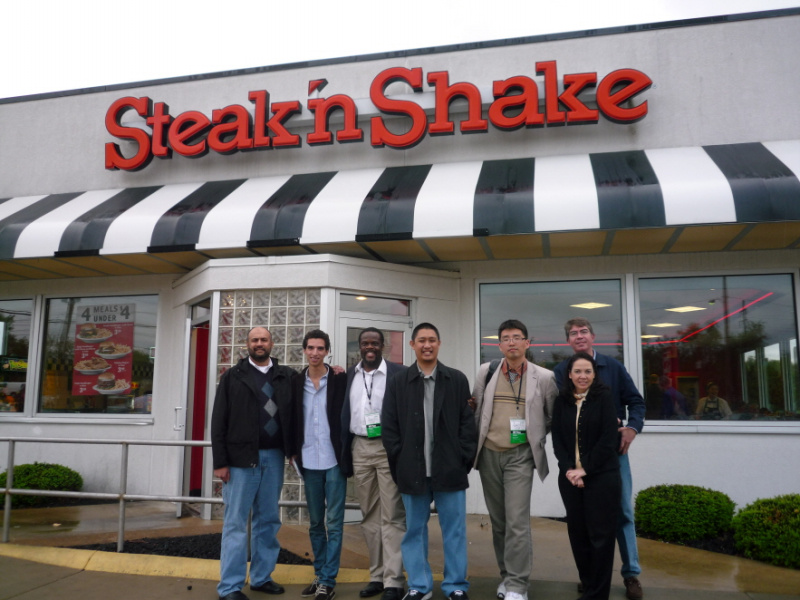
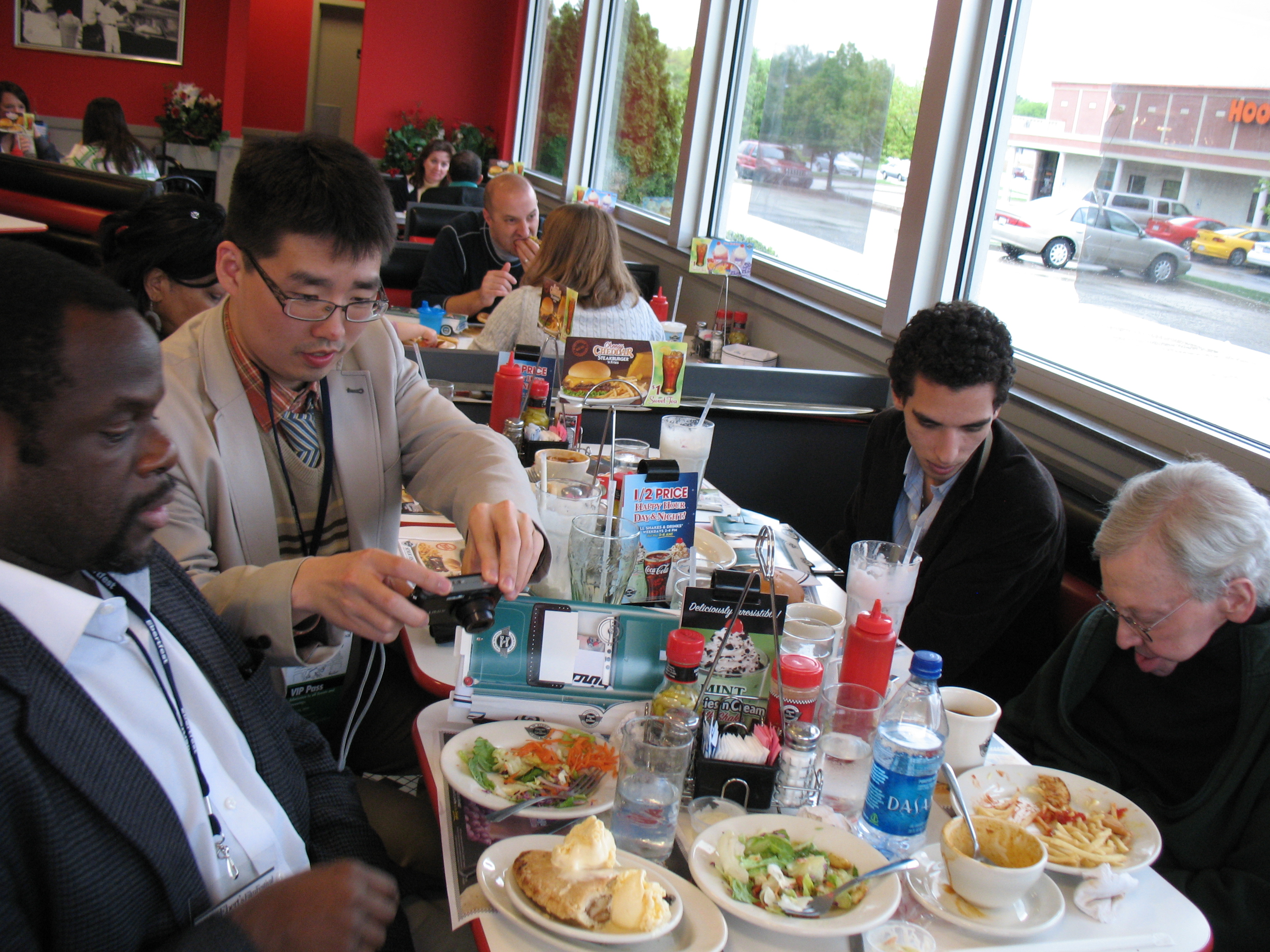
By the time I exchanged emails with the all the new people I met in the festival, Roger had left the theater. He was nowhere to be found and I feared that I wouldn’t get the chance to thank him properly and say my goodbyes. When I returned to my room, Roger sent me an email to meet him at the Steak & Shake. I met up with Michael Mirasol then and went to the address provided by Roger. It wasn’t my first time there though. Michael had set up this Steak & Shake lunch for me earlier that day. Many of the foreign correspondents and Tom Dark attended the special meal. The burger was phenomenal. Anyway, when I got there, we sat at a long table and shortly after Roger and Chaz arrived. As soon as Roger came in, our eyes were fixed on each other. He knew I wanted to spend more time with him.
It is there that I got to talk to Chaz a lot. She was surprised when she quizzed me and Omar Moore about what her favorite movie was. “I know!” I said. “It’s ‘A Clockwork Orange’”. She smiled, patted me on the back and thanked me for knowing this. We talked about Egypt more, my grandfather, our favorite films, the festival, her show, her job, how I got a job at C Mag, how she originally thought I was in my 60’s, and the Roger Ebert effect on my blog.
About half an hour later, Roger sat next to me and asked about my jetlag. I told him that I had just adjusted to the time zone. “In a way…because I was so tired yesterday making the day extra long for me, I kind of felt like I had spent three days in Urbana not one. In a good way of course”, I told him. He asked if I could go back to Chicago to spend more quality time but I couldn’t since my military permission has an expiry date. I saw the disappointment in his eyes and it broke my heart. I would do anything to spend more time with the man.I did promise to visit Chicago more often and told him that I’d tell him about my visits beforehand. We continued talking about Mary Susan and some other matters. At one humorous moment we observed as Seongyong Cho nodded. Before I knew it, it was time for him to leave. We hugged it out and he waved goodbye to all of us.
I spent two days at Ebertfest and got to talk with Roger in two occasions, once each day, both the most memorable occasions of my stay there. I wish I talked more with him there but we both knew that I made it to Ebertfest and got to spend some quality time with him and the foreign correspondents, that’s all that mattered. A viratual friendship materialized.
Later that night I had dinner with Michael, Grace and Jackson at some crappy Chinese restaurant but we made the most out of it. We laughed, joked, and talked about our home countries. After dinner we sat at the Illini Union reception and talked about our first encounters with Roger, and it progressed from there. We also talked about film criticism in general and our jobs back home. The night came to an end at Grace’s place where we chilled for hours talking about films, imitated 1-800 ads, and finally called it a night. The next morning was a sad one. I said my goodbyes and thought of how we bonded over the past two days. I also bonded with my uddy Evan that day. I spent the rest of the afternoon with the young aspiring filmmaker, soccer player, band member and comedian (talk about hard work and potential). He told me some very interesting tales about his love for the TV Show “Scrubs” and how he would wear scrubs to school in an attempt to save the show from cancellation. He took me to nice fast food restaurant that served one of the best butter burgers I’ve ever tasted. After buying some DVDs, it was time to head to the airport. We promised to keep contact.
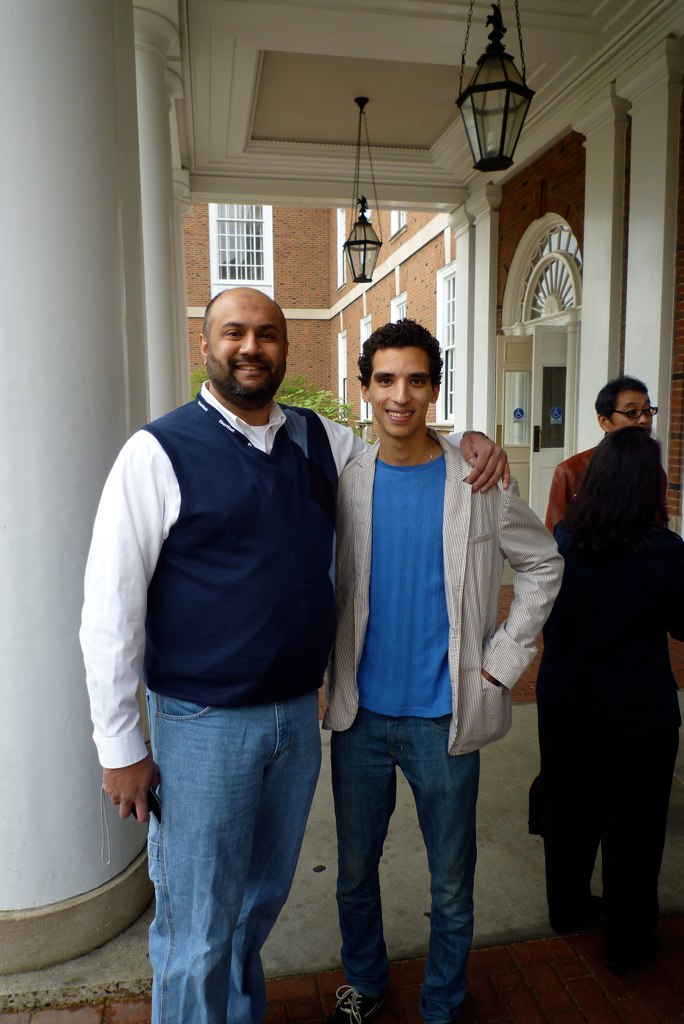
I slept through most of the fights and time passed in a fast paste. When I got back home, the same friends who did their best to find me a plane ticket to Ebertfest greeted me. They asked questions and I answered them. I told about every single detail, and they were glad to see me so happy. So was it worth it? Gerardo was so very friendly as was his wife; Omer Mozaffer treated me like a relative; Grace spent so much time with me and we got to know each other so well, it feels like I knew her all my life; Michael became the one I could identify with most having similar backgrounds; Omar Moore always made sure I was laughing and captured so many magical moments with his camera; Seongyong Cho kept me busy with debates and film conversations; Tom Dark lectured me about writing; I enjoyed watching the charismatic Ali Arikan being all over the place; Chaz was so very kind and great to talk to; Carol is another one who kept me laughing whenever we’d meet up; and talking to Roger in person strengthened our friendship in an instant. It amazes me that in a matter of 48 hours, these people evolved from correspondents and people I admired, to friends I just can’t bear the thought of never seeing again. Looking back at how we all bonded, I can no longer think of them as friends but family, one big movie loving family.
This blog post has nothing to do with the feel good motion picture “Joe versus the Volcano”. In fact, it’s far from a feel good story. This is my way of expressing my inner feelings about how the volcano in Iceland ruined my trip to Roger Ebert’s film festival, Ebertfest. The purpose of it is not to put you down or make you feel bad or sorry for me. I’m a positive man, always was and always will be. I only hope this story makes every Ebertfest attendee grateful for attending such a wonderful film festival. If you live within walking distance from the festival, a few miles away, or got there via plane, enjoy it for less fortunate individuals like myself tried everything to beat the volcanic ash, and find ways around it, only to end up grounded in the Middle East.
Where to start? I could start when I first met Roger (through his Paul Newman Tribute blog entry), or when I was first appointed his foreign correspondent from Egypt, but it’s best to start on the New Year’s Eve. I was in London for reasons I will not discuss here. What is important is that I was in the most depressive state of my life. Nothing seemed to be going for me. Roger and I were exchanging mails on a daily basis. He was very supportive and even got me to buy his wonderful book “A Perfect London Walk”. I read the book and took the relaxing walk a few days later. Then on January the 1st, 2010, Roger sent me this email:
Whilst wishing you a happy new year……here is something completely off your maps:
http://j.mp/5EofJ9
The very last clip will give you a good idea of what it looks like out a train window south from Chicago to my home town of Urbana-Champaign.
Cheers,
R
After enjoying his blog entry, and getting a glimpse of his home town, I thought to myself ‘I should visit Chicago and Urbana one day, so I replied to his email asking what the best time to visit Urbana is. The following day on January the 2nd, he responded with:
Wael, if you’re thinking of coming this way, can you come to Ebertfest, April 21-25?
We will of course give you a VIP pass, your meals in the private Green Room with the visiting actors and directors, your room at the Illini Union (student center in the middle of the University of Illinois campus), a minder to help you get around, and an invite to the closing night private party. Also, Chaz and I want to have a meet & greet for the visiting regulars from my blog, and such correspondents as Ali Arikan and Grace Wang who are coming. We will put you on a panel (‘Film Lovers in the Age of the Internet”), and try to arrange a meeting with the Egyptian Students’ Assn. on campus, if you want.
Looks like we’re showing “Apocalypse Now” in a new restored version on the big screen (see theater below).
It is a long way to fly just for Ebertfest, but you pass through Chicago and can linger. It’s an hour’s flight down to Champaign-Urbana. Also, ot course, you fly over New York, are an hour from Toronto, and can make it sort of a tour.
Among the other films we’ll show (still not announced) is “Julia,” with Tilda Swinton.
Late April is spring in Chicago although there are chilly days, but not “cold” ones. I think it is our most beautiful city.
cheers, R
You can imagine the state I was in when he sent me this. A sudden mood changer if there ever was one. I went from depressed to excited, happy and smiling in a matter of seconds. Roger pulled me out of depression and made me the happiest guy in London. Roger Ebert, the critic I most looked up to, Roger Ebert, the guy who’s film writing made me appreciate the medium as an art form, Roger Ebert, the reason I chose to become a film critic in the first place was asking me, a film critic all the way from Egypt to attend his film festival and be part of a panel discussion. Naturally, I responded with the same level of enthusiasm.
Roger, that would be great. I always wanted to attend Eberfest and actually doing so would be the highlight of my year. I will do my best to attend and visit this beautiful city. It would be an honor to attend and I can’t wait to watch “Apocalypse Now” on the big screen the way it was meant to be seen. I will make it my goal to be there but I have to take permission from the Egyptian army first. I’m not in the army but since I have 3 brothers, I have no excuse not to be by 2010 (since i’ve dodged their attempts two years already). They usually allow us to travel during holidays but since April 21 to 25 won’t be a holiday, I will have to look for an alternative way. I don’t think it’ll be a problem though since my grandfather promised to help so I’ll probably be there. I will go ask for permission once I’m back to Cairo and will update you with a confirmation soon. This made my day 🙂
Thank You (so much),
Wael Khairy
Roger didn’t stop there he made sure I kept smiling by retweeting my article “The Power of Sound and Editing (The Conversation and Psycho)” a few days later. I sent another thanking email to him on January 6:
Thank you Roger,
>
> Over the past few weeks I was watching the views on my blog gowing downhill on a daily basis. Each day I got fewer views than the previous one and then last night I check the stats and find out that over 500 people checked my ‘Editing’ article 🙂 I knew something unusual was going on hehe. Thank you for tweeting it. Is Twitter hard to use?
>
> The guest room, transportation and meals is too generous. Thank you for being so kind to me. I can’t wait to attend Ebertfest. It’ll be an experience I wouldn’t dare miss. I’m speechless regarding how helpful and generous you’ve been to me and the other foreign correspondents. Allow me to thank you on their behalf; you’re the first critic to put a spotlight on us foreign film fans. Thank you for that and for putting my blog back on its feet.
>
> Best Regards,
Your Friend,
> Wael Khairy
Roger retweeted many of my other articles some which reached over 5000 daily views. My articles were reaching a wider audience through Roger than they were through C Mag. I can honestly say there’s before Roger and after Roger. Back to the subject of this post. I returned to Cairo and got down to it. I went to get military permission. The general there was most annoying:
(All dialogue is translated from Arabic to English)
“Why do you need to leave the country?”
“Well, I’m going to attend a film festival and participate in a panel discussion.”
“Is it for educational purposes?”
“You can say so.”
“Show me proof from an educational institution.”
“I don’t have any.”
“Sorry then. I can’t give you a permit.”
“What? Why?”
“How do I know you’re not fleeing from the military?”
“I’m not. It’s only for a week.”
“People these days say they need a permit to go to hajj (pilgrimage to Mecca) only to be caught in Italy.”
“What should I do then? I need to get there.”
“We only allow permits to students travelling for educational purposes, or anyone with an official
holiday be it national or days off work. We also give permits to those visiting their parents elsewhere.”
“My father lives in Qatar.”
“Then come another time with an invitation from him. From there you can go to whatever festival it is
you need to attend.”
I didn’t bother Roger with all this hassle because worse comes to worse, I’d tell my grandfather (former prime minister of Egypt) and he’d make his phone calls. I know I could’ve done that from the start but I don’t like bothering the old man with my troubles. Anyway, I got the guy an invitation from my father and he gave me the permit a few weeks later.
Now I had to obtain the American visa, so I went to the embassy. They were very helpful there being straightforward with all the necessary documents needed. One of which was an official invitation from any representative of Ebertfest. I contacted Roger who pointed me to Mary Susan Britt. She was very helpful and kind through all of this. She sent me the invitation to the film festival and a month later I ended up with the visa that expires in ten years.
After that, I booked my tickets. Naturally, I had to make a stop in Qatar. So my tickets were to be from Cairo to Doha, from Doha to London, from London to Chicago and from Chicago to Champaign. I called my travel agency and they booked all the flights for me and I provided the wonderful Mary Susan with all the flight numbers.
Meanwhile, Roger was writing some of his best work. Blog entry after blog entry, we got an insight into the man not the film critic. I already knew Roger was a film critic among film critics but through his blog posts and our virtual friendship I discovered a human among humans, a man among men.
He’s the one who drove me to twitter, the one to resurrect my blog and played the role of a matchmaker, matching my blog with my target audience, film lovers. If it weren’t for him and twitter I probably wouldn’t have met the foreign gang. Michael Mirasol, Omer Mozzafar, Grace Wang, Ali Arikan, Omar Moore, etc.
Roger guided me through a doorway, into an internet world I did not know existed. I have thanked him so many times. He probably got tired of my “thank you(s)” and I don’t care, they’ll keep coming towards his way. More than anything I wanted to shake his hand. I played this handshake a thousand times in my head. It became surreal. I often found myself thinking “Holy shit, Roger Ebert digs my blog and wants me to attend his film festival.” He became the subject of my discussions everywhere I went. My grandfather would ask me to read his articles to him, my friends showered me with questions about the film festival, and the regulars in cafes who only had a “El Salam alaykum” relationship with me would eavesdrop while smoking their shisha and as soon as they heard the name Roger Ebert, they’d turn to me and ask questions. I must’ve told the story of how we first met on his blog a thousand times, or how friendly he is with film lovers, and of how much he cares about his fans.
My brothers would call me and his tweets were often the subject of our conversations. His reviews kept inspiring me to work harder, write more, and so on. By the end of March, everyone I saw, everyone I knew, everyone related to me knew about my going to Ebertfest. Most of them wanted to see me one last time before leaving to Qatar. They’d ask me about the panel discussion. “How can we watch it?” “Will it be streaming live?” “Will it be on TV?”, “What are you going to say?” The answers to the first three questions I knew, but what am I going to say? I never thought of that till they asked me. All I knew was that the panel discussion was about “Global Film Lovers on the Web”.
I probably never asked myself what I was going to say because I already knew it. I’m an Egyptian film critic writing for Egypt’s first and only English language magazine devoted entirely to film. I also write about film more freely on this blog, all in English, my second or maybe third language. The panel discussion was perfect. It would allow me to express everything I have to say about my role on the internet.
You see in Egypt, 45% of the population is illiterate. Of the remaining 55%, only a small percentage can read English. People in Egypt depend on broadcast more than printed media, so the internet provides an open door way to reach a much wider audience. It’s not just that. My role as an Egyptian film critic on the web is one I’m very proud of. Let me explain. When it comes to mass communication, be it an article or a film review, the flow of information has always been from the West to the Middle East or Far East and so. My point is, it was always a one way flow.
The internet is the first type of mass communication that supports a two way flow in a borderless world. Still, if you think of the internet as this global media empire, you’ll find that it’s dominated by certain core nations (US,UK, etc.) and these core nations impose their culture on developing nations, so what Roger essentially did with this new foreign correspondents feature is more or less genius because now we’re no longer at the receiver’s end of the flow of information. This supports the concept of a balance of information flow.
I think Roger’s film website is the first of its kind and by that I mean it’s the first website to offer a global perspective on films. In other words Roger Ebert basically decentralized online film criticism. I can only encourage more and more foreign film fans to represent their views on films throughout the internet. This is crucial especially in the Middle East. Everything from newspapers and magazines to broadcast news is becoming too pro-government in Egypt. We barely have any independent newspapers. All the major ones are government owned and function only as government mouthpieces. Only in the last few years have Egyptians given up their trust of the media and resorted to the internet for the truth. Yes, blogs are being monitored and so on but still I believe with technological advancements and more and more internet users, the internet will be the key to freedom of expression in the Arab world.
I just realized that I wandered too deep into the topic of the panel discussion. Damn it! I want to be there when that discussion starts! I’ll stop here and go back to where I left off. Yeah, so basically everyone I know knew about Ebertfest. They told their friends, etc. etc. It was news. My grandfather wanted to write an article about me going to Ebertfest in Al-Ahram (Egypt’s main Arabic newspaper). I convinced him not to do it because “I didn’t want to Jinx it”.
I asked all the foreign correspondents, Roger, and Mary Susan what they wanted from Egypt, nobody wanted anything. I expected that response and got them all Egyptian gifts anyway. All they wanted was for me “to be there”, or “my presence”. How ironic that I can’t even give them that. I read once that Roger’s house is filled with items of places he visited, (African chairs, etc.), so I wanted a piece of Egypt to be there. My grandfather also wanted me to give him a book he wrote in English, “Life in Ancient Egypt”. It’s a wonderful book. He wrote a note inside, signed and stamped the note and asked me to give it to him personally. It would break my heart if I had to give the book back to the 92 year old man.
The days pass, my excitement boosts, and I take my first step to Ebertfest, Qatar (Doha). My father picks me up and we head to his house. By then the volcano has already erupted but is not nearly the center of the media’s attention as it is now. I discover that flights are being cancelled on the 16th and 17th, but am in no worry since my flight to London is on the 19th and from London on the 20th. As the hours pass, I become more and more worried. More flights get cancelled; more people are grounded in airports all over the world. I was foolish enough to wait with hope that my flight wouldn’t be cancelled. The day finally came that my flight got cancelled. The arrival of the news triggered my heart to drop, it was as if warm water ran through my entire body. I didn’t know what to do, as I sat in front of the screen of my laptop. I reread the news about 5 times in hope that the words would somehow change. They didn’t.
For an hour or so, I sat in the living room silent. I didn’t even tell my father. I just wanted to think about an alternative. When I finally broke with the news, Roger and my dear fellow correspondents sent me how sorry they felt, but I still had hope. My father drove me to nearly twenty travel agencies; all of them had no routes. I told my best friend in Egypt about the news, Amina El Shazly. I think she wanted me to go to Ebertfest more than anyone. As I went from one agency to another with less hope on every trip, she was doing the same back in Cairo. Soon all the people who knew about Ebertfest in Cairo were calling me with concern, everyone trying their best to get me to Chicago. As I stayed up all night trying to find a way around the volcano, they were hopping from one travel agency to another. My brothers called every airline they know of.
Today, even though I had officially announced that I wouldn’t attend Ebertfest. I still tried, this time through the web. My friends and family in Cairo sent me emails with links to possible sites that may help (cheaptickets.com, Thomas Cook, etc.). I no longer tried to exchange tickets; I just wanted to buy new ones. I didn’t care if I had to pay double the price; my urge to go to Ebertfest only grew. I even bought tickets from a website only to discover that they were tickets to a flight already cancelled. A refund was given in return. Finally a few hours ago I found a multi-ticket solution in some website. It would take me through Italy and from there to Chicago. I called those who were looking for tickets and told them to look no further. I then clicked on the tiny PROCEED TO PAYMENT box, when the website asked to refresh since I had spent too much time on the page. I refreshed and the ticket was sold in that instant to someone else.
I must’ve read more than 30 “No flights on that date.” notes from plenty different websites. The thing is, people all over the world were doing the same thing. How stupid of me to wait a second or two before buying the ticket. Most airports have shut down by now and I can’t find any tickets online or elsewhere. The only few I can find are going for tens of thousands of dollars and I can’t afford any of that. While most airports are losing millions, online travel agencies are taking advantage of the volcano incident and selling for ridiculous prices.
I’m writing all this to finally give up on my quest and come to terms with the conclusion. I’m tired and I’m sick of being disappointed over and over again. You can imagine how sad I am for not being able to attend. Still, the fact that the other foreign correspondents made it comforts me. I want them to enjoy it. I want everyone attending Ebertfest to enjoy every second there and be grateful for sitting in the seats of the festival. I will be following any blogs about the fest and will be watching the panels online. I advise you to do the same. I can’t think of a group of individuals more suited for the job than them foreign correspondents. I can only hope to be attending next year. It’s time to start my countdown to Ebertfest 2011.
At first the iconic sign read “Hollywoodland” after that “land” was removed and it has been known as “Hollywood” ever since.
When one hears the word’ Hollywood’, the first thing that pops in mind is movies. There’s a reason why Los Angeles became the center of motion pictures. It all started with a few independent studios that ventured as far away as possible from “the trust”, mainly Thomas Edison and his lawsuits, and so they headed to L.A. to distribute, produce, and exhibit their movies. The fact that Los Angeles was far away from New York helped make it the home for independent film studios. Even though there was still a presence of the major film studios in Los Angeles, it was not till after independent film studios realization of the positive aspects about L.A.’s location that Hollywood was finally established. The four major positive aspects were basically the fact that L.A. was sunny all year long, the property was inexpensive, it was an open shop town, and of course the variety of locations and geography. These conditions made it perfect for any studio to shoot movies. Soon almost every studio be it major or independent wanted to settle there, making Hollywood full of film factories.
Once Hollywood became the center of the film industry in the US, a system had to be established which introduces us to the studio system. The system was first and foremost designed to ensure the cost and quality of the movies being produced. Having a system made Hollywood a much more organized film industry than anywhere else in the world. There was a clear division of labor from the producer, to the screenwriter to the actors and director. All screenplays had to be approved by the producer and established a kind of guideline and draft of what the end product will be. Soon MGM, Paramount Pictures, RKO Radio Pictures, and Warner Bros. were leading the film industry in a well-defined system. Smaller studios like Universal Studios, United Artists, and Columbia Pictures were also rising to take their share of the evolving industry. The age of Edison was coming to an end, and a new entrepreneur with high expectation, Adolf Zukor, took control of Paramount Pictures and tried to lead the studio system.
Once in charge of Paramount he added a practice to the system known as block booking. The idea of block booking was to sell multiple films to theaters ahead of time in one quantity. This ensured that the studios would gain profits ahead of time and that theaters would have films to play all year long. As a result 90% of movies shown in the US were American movies and due to a large domestic audience being such a large country, profits were higher than anywhere else in the world. However, Hollywood with its studio system and great qualities for shooting movies wasn’t the capital of the film industry in the US alone. In fact, its success became worldwide.
Having a broad based US culture, there was a sudden wide appeal and people all over the world became suddenly interested in Hollywood movies. As for European cinema, while they were still in competition, the effects of WWI destroyed the European film industries. It was mainly due to the conversion to propaganda films. Therefore, while Europe was suffering from the war trying to focus on propaganda instead of the film industry, Hollywood was growing with a strong system and eventually became the leading film industry of the world. European cinema tried to make a comeback but was never able to achieve the heights of the Hollywood system, and to this day, Europe has failed to recover from the effects of WWI on their film industries placing Hollywood ahead of their time.
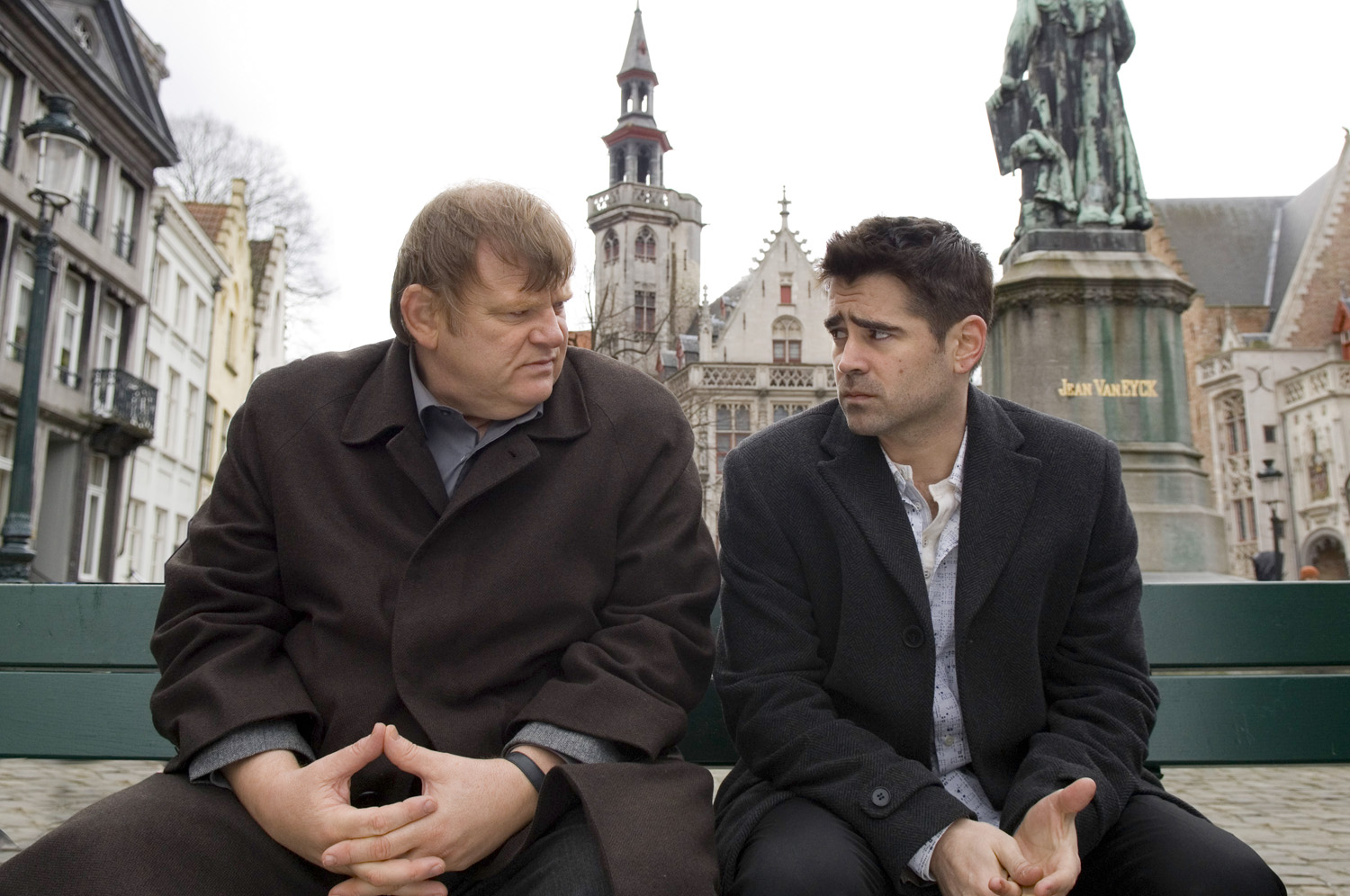
When a movie deals with such heavy topics as atonement, redemption, the after life, death, guilt, honor, friendship, and suicide, it’s naturally becomes hard for a viewer to swallow such heavy subjects in an hour and a half, which is why the hilarious humor of the most original screenplay of 2008 makes it a piece of cake for the audience. Take this example of an exchange of dialogue:
Ray: Why didn’t you wave hello to me today when I waved hello to you today?
Jimmy: I was on a very strong horse tranquilizer today; Wasn’t waving hello to anybody. Except… maybe to a horse. Ray: Huh? What are you talking about? Jimmy: Just horseshit. Ray: You from America? Jimmy: Yeah. Don’t hold it against me. Ray: Well, that’s for me to decide, isn’t it? Ray: [to Denise] You from America too? Denise: No, I’m from Amsterdam. Ray: Amsterdam! Amsterdam’s just a lot of bloody prostitutes, isn’t it? Denise: Yes, that’s why I came to Bruges. Been trying to get a better price for my pussy here. Ray: Huh?
[pause] Ray: You two are weird. Would you like some cocaine?
If that didn’t do it for how about this scene which is possibly my favorite of this little gem:
Ken: And at the same time, at the same time as trying to lead a good life, I have to reconcile that with the fact that with the fact that, yes, I have killed people. Not many people. And most of them were not very nice people. Apart from one person.
Ray: Who was that? Ken: This bloke Danny Aliband’s brother. He was just trying to protect his brother. Like you or I would. He was just a lollipop man. But he came at me with a bottle. What are you gonna do? I shot him down. Ray: Hmm. In my book, though, someone comes at you with a bottle, I’m sorry, that is a deadly weapon, he’s gotta take the consequences. Ken: I know that in my heart, but I also know he was trying to protect his brother, you know? Ray: I know, but a bottle, that can kill ya. That’s a case of “It’s you or him”. If he’d come at you with his bare hands, that’d be different. That wouldn’t have been fair. Ken: But technically, someone’s bare hands, they can kill you too. They can be deadly weapons too. What if he knew Karate, say? Ray: You said he was a lollipop man. Ken: He WAS a lollipopman. Ray: What a lollipop man doing, knowing fucking Karate? Ken: I’m just saying… Ray: How old was he? Ken: About fifty. Ray: What’s a fifty year old lollipop man doing, knowing fucking Karate? What was he, a Chinese lollipop man? Ken: Course not. Ray: Well then.
I consider “In Bruges” the “Pulp Fiction” of the naughties. A film daring to mix the darkest of drama with the funniest of humor all in fucking Bruges.
Vaudeville houses existed long before nickelodeons and movie theaters. The main idea behind a vaudeville house was to display live acts, each lasting between five to ten minutes to an audience. While the upper class wouldn’t venture into these houses, by the late 1800’s they were the dominant form of mass entertainment. The acts often showed the unusual, or comedic acts, and various other entertaining acts such as magician performances. Their success was probably due to the very cheap admission price, between five to ten cents. There was also a weekly change of acts and this worked out perfectly because performers would travel from all over the country to perform their acts to different audiences in different states. That way there was always something new to the audience and the performers were constantly in employment. This method was called the interstate vaudeville circuit and was one of the main reasons why people were drawn to these houses week after week.
However, the significance of vaudeville houses to motion picture history can be traced back to when the Lumiere brothers arrived to the US. Once there, they would hook their cinematograph to the magic lantern and project their short films to a live audience in vaudeville houses. Edison naturally felt that they were a threat to his growing empire of film business since prior to their arrival people could only watch these short films individually through a kinetoscope. People were getting tired of these single film presentations and the idea of watching a short film with a large audience seemed a lot more appealing and therefore Edison imitated the Lumiere brothers and projected his short films in vaudeville houses across the nation as well. One can clearly see how vaudeville houses triggered the idea of a modern theater. The friendly atmosphere and crowded audience lead to nickelodeons. Nickelodeons would then coexist with vaudeville houses but primarily focused on short films instead of acts. Later on deluxe theaters were built and they became the go to place for film fans, yet it all started with these old fashioned vaudeville houses that introduced the simple idea of an audience sitting together to enjoy some sort of entertainment for a low admission price. This helped the film industry find its target audience, everyone.
The deluxe theater plays a very significant role in establishing the early development of film. The reason for that being is because prior to these theaters being built, nickelodeons and vaudeville houses would only play short films. One may very well claim that the rise of deluxe theaters lead to the decline to both vaudeville houses and nickelodeons. While nickelodeons and vaudeville houses co-existed often playing short films and acts with nickelodeons playing more fictional short films than having acts performed and vaudeville houses vice versa, both were the public’s main source of entertainment. However by 1915 and the success of feature films, everything changed. Deluxe theaters were newly constructed and built unlike nickelodeons which evolved from vaudeville houses. These theaters were not a conversion of any sort, for feature films could not play on nickelodeons and so they had to build deluxe theaters.
Now that the film industry was booming, the deluxe theater offered a lot more than the old fashion entertainment houses. Firstly, they were a lot larger having the ability to hold a capacity of up to 6000 seats. There was the casual weekly change of program and each week the decorative exterior would light up a new movie title in colorful light bulbs. They also offered a better service for a lot of labor was required to operate a deluxe theater from ticket sales to ushers walking customers to their assigned seats, etc. Naturally with better service and a cleaner environment, the prices went up. Instead of paying five or ten cents, tickets cost between one and two dollars. Therefore films were no longer for the lower class only, and eventually the middle and upper class would consider films as an appropriate form of entertainment. S.L. Rothafel can be credited with making deluxe theaters such a pleasant environment, for his motto was to treat the audience like kings and queens. He later added a cooling system and theaters were air conditioned for the first time in history. However with all these special services such as printed programs, and air conditioned theaters, the film industry never lost its audience for everyone could afford to attend these theaters every once in a while. In fact, these deluxe theaters only made motion pictures the dominant form of entertainment.
Teddy Daniels (Leonardo DiCaprio) walks the dark empty hallway of a mental institution. The tiny flame of his match goes off. He lights another one. A couple of minutes later a man behind bars tells him “Don’t you get it? You’re a rat in a maze.” So is the viewer.“Shutter Island” is a psychological thriller unlike any I have ever seen. It is also probably the most atmospheric thriller you will see all year.
The year is 1954. US Marshall Teddy Daniels and his partner Chuck Aule (Mark Ruffalo) arrive at Shutter Island after their ferry breaks through a mysterious mist. The island is an institution for the mentally or criminally insane. One patient has escaped and their task is to investigate the matter. As Teddy digs deeper into his investigation, he loses control of it. Soon he is not sure of what or whom he is investigating, as the investigator becomes the investigated. One thing he does know is this, there is no escaping the island. The patient could not have escaped because he soon discovers he cannot escape as well. There is a secret behind this island; both the viewer and the main character feel that from the start.
I could not help but admire Scorsese’s control over every element in this film. I saw similarities to the brilliant “Eyes Wide Shut”. Yes, both are entirely different films but with both, the viewer takes a journey through the mind of the main character. We see what he sees, we feel what he feels and we eventually reach the truth through his eyes. A psychological thriller if there ever was one, “Shutter Island” will keep you guessing until the very end. At times, the flame will brighten the situation and in a split second, you will be back in the dark, lost, confused and desperate to figure out what it is about this island that feels so wrong.
The film depends on a twist. It is not until after that twist that a masterpiece emerges. “Shutter Island” is a motion picture that demands repeated viewings. Prior to this movie, the only Scorsese film considered a film noir is his 1976 classic, “Taxi Driver”. While “Taxi Driver” is a psychological neo-noir, “Shutter Island” has a more traditional noir feel to it. We have our cigarette-smoking investigator, the complicated mystery, the low-key lighting and the rainy weather.
It is extremely difficult to discuss a film that relies so much on its ending without spoiling the whole film. For this is one of those films that generate conversations after the initial viewing. I know that I will be returning to the doomed island in the near future, and once I do, I will be judging with a more careful eye. I will take note of certain aspects that slipped my mind as a first time viewer. It is the duty of a film critic to let you know what to expect without spoiling the film. Therefore, I will do my best in the coming sentences to let you know what it is that you are in for without revealing any spoilers.
You will start out a tiny fish swimming in a pond. As the plot thickens, you evolve into the angler who keeps an eye on the confused fish. By the end of the film, the viewer becomes the person standing on the rock studying the angler who himself is studying the fish. In other words, you may get lost. You may not be aware of what is happening during the duration of the film but as the film goes on, you get glimpses of the bigger picture and eventually you reach it.
What you make out of the truth of the matter will determine your opinion. I can only speak for myself. I was both dazzled and astonished by how Scorsese managed to keep me blindfolded for so long without having me lose interest. “Shutter Island” is nothing short of a cinematic masterpiece, a journey into a character’s mind, a mystery within another mystery, an open door to a mastermind at work.
The winners are finally announced. This year seemed like the most predictable. However, there were some surprises that no one saw coming. Particularily “Precious” winning Best Adapted Screenplay over “Up in the Air”, and “El secreto de sus ojos” winning Best Foreign Film over “The White Ribbon” and “A Prophet”.
As for the upsets, for me there were three: “Up in the Air” losing to “Precious”, Quentin Tarantino leaving empty handed and of course “The White Ribbon” losing both Best Foreign Film and Best Cinematography, two categories it deserved more than the competition.
Still overall, it was a good night, and it was a relief to see “The Hurt Locker” sweeping 6 big ones including “Best Picture” and “Best Director” making Bigelow the first female best Director winner.
As for my predictions, it wasn’t my best year. I have come up with more accurate predictions in the past. Still 16/24 is one of the better predictions out there.
*The films with a star next to them are the ones I predicted correctly:
Tim Burton’s “Alice in Wonderland” begins ten years after the events of the original tale. In that sense, it is a sequel or a return to wonderland. However, Burton’s film is full of scenes and lines of dialogue lifted directly from the original books by Lewis Carroll. It is here that the film fails. I did not know whether this was an adaptation of the original or a sequel, it’s best to think of it as a reimagining.
Mia Wasikowska stars as a nineteen-year-old Alice. Long after her first encounter with wonderland and by now long forgotten, she returns once again. Her mission is to save the beautiful land from a wicked witch, the Red Queen (Helen Bonham Carter). Of course, on her journey she meets a handful of quirky characters who have been expecting her. The Mad Hatter (Johnny Depp) leads her to the White Queen (Anne Hathaway), sister of the Red Queen. It is fairly easy to predict the rest.
Watching this on the big screen will be a treat for children. The visuals are stunning and Burton supplies us with a film that is a feast to the eye. Do not expect to enter a 3-D world equivalent of Pandora, but still enjoy your brief stay at wonderland, for some of the CGI shots and landscapes are jaw dropping.
Depp delivers the usual bizarre performance, we come to expect from him in a Burton collaboration, but my hats go off to Bonham Carter who steals every scene she’s in. Her humorous performance both made me laugh and gave me the creeps.
So far, all I have mentioned is the positive, or more precisely the only positive aspects about this film. There are no twists and turns here and besides being visually impressive there is not enough substance to make it memorable. In fact, “Alice in Wonderland” reminded me of “Chronicles of Narnia”, perhaps a bit too much. I can’t praise the originality for that it isn’t, I can’t praise the story, for we’ve seen it all before, I can, however, praise the visuals, the only element that stayed with me after the credits.
“Alice in Wonderland” is only the third film ever released in 3-D here in Egypt. I would not much care if it were the last. Visuals alone cannot save a picture. With the sudden 3-D movement in Hollywood, this is exactly what I feared, filmmakers focusing on the technical elements and ignoring the story and heart of a movie. Watching this 3-D film felt like going on a date with a beautiful young woman and discovering she has no soul.
Alejandro Amenabár’s ‘The Others’ opens with a series of spooky hand drawn title shots. The last of these images is that of an old house. An excellent use of transition follows, as the hand drawn house fades into an actual house. ‘The Others’ feels like a Victorian ghost story written by Michael Cox, J. Sheridan LeFanu or Wilkie Collins. With that transition, it is as if Amenabár lifts the pages of one of these great old ghost stories directly to the screen.
Nicole Kidman plays Grace in a performance that is not your typical take of a horror movie heroine. Kidman uses realism rather than generic acting to introduce the viewers to a flawed, emotional, and troubled woman. Grace lives with her two children in an old mansion in the middle of nowhere. Anne (Alakina Mann) is the daughter and Nicholas (James Bentley) is the younger boy. However, soon three mysterious servants arrive. Since their arrival, a series of strange incidents occur as they all discover they are not alone.
Indeed, the plot is that of a typical haunted house movie. However, ‘The Others’ is much more than that, for it is quite possibly the greatest ghost story ever told on film. This is largely due to all the thought and attention Amenabár gave to his picture. This is one of those rare occasions where the director had total control over his material. Besides taking the helm, Amenabár also wrote the perfectly contained screenplay and composed the haunting yet emotional score.
The director uses metaphors and German Expressionism to tell his story. Like many expressionistic films of the later stages of that era in German film history, the expressionism in ‘The Others’ lacks exaggeration but is still nonetheless very expressionistic. The film borrows themes of the lost genre by dealing with insanity, madness, mirrors and a dark urban setting.
The atmosphere in the giant mansion is very dark as the use of light and shadow play key factors. Amenabár is a genius when it comes to metaphors and the use of light and shadow in his film are exactly that, a giant metaphor. Most of the film takes place within dark rooms and dim hallways with flames of candles in lanterns as the only source of light. The audience is kept in the dark throughout the movie and it is not until we reach the explanatory twist that sunlight symbolizing knowledge pours into the house and our minds.
I always wondered why the ghosts in haunted house movies only appeared when the room was dark or it was nighttime. Here Amenabár is generous enough to provide us with a reason for the film’s dark atmosphere. We learn that the children suffer from an incurable illness known as xeroderma pigmentosum preventing them from any direct exposure to sunlight. If the pores of their skin meet any such exposure, the result will be a severe outburst that will lead to their death. Ironically, when the children finally reach “the light” or knowledge of the truth behind the intruders, they end up dead in that we discover they are ghosts.
What impresses me most each time I watch ‘The Others’ is that the style and substance complement each other creating a visually beautiful movie with enough substance to merit repeated viewings. Studying the film shot by shot, I discovered a master in control of every frame. Each scene is part of a whole and every shot is there for a reason. Allow me to point out examples in the film to support my gutsy statement.
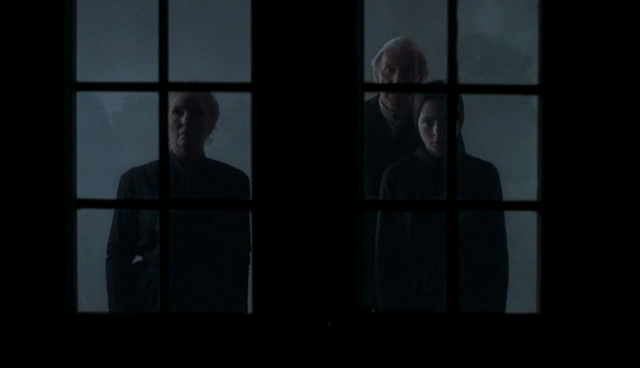
We are given a time frame when Grace explains to the servants that the postman has not passed by in a week, that it’s been a week of silence as the birds stopped singing, and that the fog lasted a week. Therefore, it is safe to say, they have been dead not knowing it for a week from where the film picks up. The fog plays an important role here as Grace attempts to walk through it seeking a priest to rid the mansion of the “ghosts”. However, since they are dead, Grace and her children are tied to that house and the fog prevents them from going beyond a certain point. Of course, a first time viewer does not discover that until after a second or third viewing. Look at the shot below where Amenabár expresses this entrapment visually.
‘The Others’ is full of such expressionistic shots. The most famous scene in the film is when Anne wearing a new white dress plays with her puppets. Grace having left her daughter in that room, later returns where Anne still wearing the dress continues to play with her puppet. Only this time she is an old woman. The scene is both unsettling and disturbing yet there is more to it than meets the eye. We later learn that the old woman is a medium who was at one point possessed unintentionally by Anne. This is why Anne takes on the form of the old woman earlier in the picture. Now look at this shot, which takes place before the viewer discovers any of this.
Anne in her communion dress plays with a puppet. The puppet is an old woman and Anne is in total control of that puppet/old woman. Again, a visual representation of what is happening.
‘The Others’ is full of such hints. Not all are visual; some are contained in the dialogue. For instance, after Grace shouts at Anne for misbehaving, Anne starts to breath unevenly. “Stop breathing like that”, Grace tells her. The breathing only gets louder and Grace gets mad and screams, “Stop breathing!” This is a subtle reference to the day Grace went mad suffocating her children using a pillow causing them to “stop breathing”. Later on, this subtle reference to the cause of death happens once again, only this time with Nicholas. As the children hide in the cupboard, Nicholas gasps for air and Anne asks him to “stop breathing like that” or they will get caught. The migraines Grace suffers from throughout the movie may refer to her cause of death, using a gun to blow her brains out.
One scene that caught my attention is when Grace rushes up the house and gets the shotgun. Before she cocks it, there is a déjà-vu expression on her face. It is as if she has done this before. This only shows the dedication Kidman had to that performance.
The twist in ‘The Others’ as many of us know is a big one. The entire picture builds up to that twist. That does not mean after the unraveling of the twist the movie becomes less watchable. In fact, it is the exact opposite of that for the entire film supports the ending and part of the fun is to catch all the indicators a second, third, or fourth time around. How can we appreciate the lines of Mrs. Mills (Fionnula Flangan), the head servant, having watched the movie only once? At one point she tells Grace that sometimes the “death of a loved one can lead people to do the strangest things.” It is such well thought out lines, perfectly composed shots and complementary scenes that makes ‘The Others’ a ghost story unlike any other.
I am aware that calling this film the greatest ghost story of all time is a bold statement. I have seen ‘The Haunting’ and ‘The Innocents’. Both are excellent haunted house films and had great influence on this 2001 movie. However, ‘The Others’ never fails to impress me, more so than the other two, most because of its depth. I am also aware of the fact that many will pan me for these statements. The great Roger Ebert often says, a critic has to be true to his feelings and not merely follow the general consensus of critics. This is how I felt about what I consider a masterpiece of cinema and I stand by my feelings and opinion.
Memento mori or photographs of the dead is a theme eplored in ‘The Others’. Here are some spooky real life pictures of the Victorian era:



















 The Cinephile Fix